


Introduction: Why blog structure matters in 2025 (and for AI search)
Your audience - and Google - can spot generic AI content a mile away. In 2025, the posts that win are simple, scannable, and human-first. That’s why structure is your unfair advantage. With a clear outline, logical H2/H3s, and strong on-page elements, your blog writing turns into content that ranks, gets cited by AI Overviews, and actually gets read. At BlogBowl, we help SaaS teams and startups operationalize that structure so you can publish high-quality, SEO-ready posts at scale.
"88.2% of businesses expect content marketing budgets to grow or stay the same in 2025 (up from 54.5% in 2024)." - Source
The problem with generic AI content and messy blog writing
Thin, lookalike posts flood the SERP, but they’re hard to skim, light on proof, and heavy on filler.
Walls of text, inconsistent headers, and no internal links hurt engagement and time-on-page.
Result: even decent ideas get buried because the experience isn’t built for humans - or modern search.
If writing blog posts feels slow and the outcome feels “meh,” it’s usually a structure issue, not a creativity issue.
Why structure + clarity beat keyword stuffing in modern SEO
Search engines prioritize intent-matching, clear information architecture, and helpful formatting over keyword density.
Clean H2/H3 hierarchies, descriptive subheads, and short paragraphs make blog and article writing easier to parse - for readers and crawlers.
Internal linking, relevant anchor text, and logical flow signal topical authority.
Bottom line: best practices for blog writing are now UX practices - clarity, hierarchy, and coherence win.
How AI Overviews and LLMs reward scannable, people-first posts
AI Overviews and LLMs extract concise definitions, checklists, and step-by-step sections that are easy to parse.
Posts with crisp intros, ordered lists, FAQs, and evidence-backed claims are more likely to be summarized or cited.
Clear section headers (H2/H3), short “definition-first” answers, and consistent terminology help AI find and quote your content.
People-first formatting - bullets, tables, and tight paragraphs - improves both human engagement and AI discoverability.
What you’ll learn in this guide (research, outlines, on-page elements, linking, examples)
A repeatable framework for content writing blog posts: research, outline, draft, and optimize.
How to turn a keyword into a scan-friendly outline that maps to search intent and reader needs.
On-page essentials: headings, internal/external linking, schema opportunities, and multimedia choices.
Practical examples of a written blog going from outline to publish-ready - and how to avoid common pitfalls.
A checklist for blog entry writing that keeps every post consistent, fast, and ranking-ready.
Who this is for: SaaS teams, startups, and marketers who need repeatable blog writing frameworks
SaaS founders and product marketers who need a documented, scalable writing process.
Content managers building an editorial engine for growth-stage startups.
Marketers who want consistent, high-quality writing blog outputs without micromanaging every draft.
If you want a structured, AI-aware approach - and the tooling to automate parts of it - BlogBowl gives you SEO-optimized templates, automated outlines, keyword research, internal linking, and publishing so you can focus on strategy and audience, not setup.
Find a winning keyword and align with search intent
Picking the right keyword isn’t just an SEO checkbox - it’s the compass for your entire article. When you anchor your post to a keyword that aligns with real reader intent, your blog writing becomes more focused, your outline becomes tighter, and your chances of ranking (and getting cited by AI Overviews) increase dramatically.
"Create helpful, reliable, people-first content." - Source
Start with reader pains and jobs-to-be-done (write for people first)
Start with outcomes, not keywords. Before any blog and article writing:
Identify the core pain: What problem is your reader trying to solve today?
Clarify the job-to-be-done (JTBD): What progress are they hiring your content to achieve?
Determine success: What result would make this a “bookmark-worthy” article?
Quick prompts:
“When [persona] tries to [job], they struggle with [barrier], which causes [risk].”
“They’re searching because they want to [goal] without [undesired tradeoff].”
This people-first lens keeps your content writing blog posts relevant, helpful, and conversion-oriented.
Build your keyword set: primary, long-tail, and semantic terms
Turn pains into a structured keyword set that guides a written blog:
Primary keyword (the main target): A high-intent phrase that exactly matches your topic (e.g., “how to write a blog post outline”).
Long-tail variations: Specific, lower-competition phrases (e.g., “blog entry writing outline for SaaS,” “blog writing structure for startups”).
Semantic terms: Related entities and concepts Google expects to see (e.g., “search intent,” “People Also Ask,” “H2/H3 structure,” “internal links”).
Ways to source terms:
Autocomplete, Related Searches, and People Also Ask.
Competitor top pages and headings.
Search Console queries you already own.
Industry language from customer calls, tickets, and sales notes.
Natural usage is key - avoid stuffing. The best practices for blog writing emphasize clarity and semantic coverage over repetition.
Validate the SERP: top formats, PAA questions, AI Overviews, content gaps
Before you commit, validate alignment:
Identify top formats: Are winners list posts, step-by-steps, “what is” explainers, or comparisons?
Scan PAA questions: Add them as H2/H3s your audience cares about.
Check AI Overviews: What concise definitions, steps, or checklists are being extracted?
Map features: Image packs, videos, FAQs, snippets - optimize your structure accordingly.
Spot gaps: Outdated years, thin examples, missing data, no internal linking, weak CTAs, or lack of SaaS-specific context.
If your angle uniquely serves the unmet need, you have a viable content gap to fill when writing blog posts.
Choose attainable difficulty and traffic potential for faster wins
Pick a keyword your domain can realistically rank for (match Domain Authority vs. competitors).
Prefer traffic potential (total topic value) over raw search volume.
Prioritize long-tails for quick wins; use them to support the primary keyword.
Balance portfolio: Some posts go after head terms; others compound authority with easier wins.
BlogBowl tip: Our platform automates keyword clustering and internal linking, so each blog entry writing session builds topic authority over time.
Deliverable: a one-sentence intent statement for your blog entry writing
Use this to align your outline, headers, and examples:
Template: “This post helps [persona] who need to [job-to-be-done] by delivering a [format] that solves [specific pain] and answers [key sub-intents], targeting [primary keyword] with supporting terms [long-tails/semantics].”
Example: “This post helps SaaS marketers who need to validate topics quickly by delivering a step-by-step guide that solves ‘how to pick keywords by intent’ and answers PAA questions, targeting ‘keyword research for search intent’ with supporting terms ‘long-tail keywords,’ ‘SERP analysis,’ and ‘AI Overviews.’”
Short caption: Learn the 10‑minute routine - brainstorm pains → derive seed terms → analyze SERP intent and PAA → cluster long‑tails/semantics → pick an attainable primary keyword and map your H2/H3s.
Pick the best format and map the outline (the inverted pyramid)
Choosing the right format is half the battle. It aligns your article with search intent, sets reader expectations, and makes your outline obvious. Then, the inverted pyramid helps you structure information so readers get value instantly - and can go deeper if they want.
Match format to intent: how-to, list, “what is,” comparison, case study, beginner’s guide
How-to: Best for step-by-step tasks and workflows.
Listicle: Ideal for curated ideas, tools, or best practices.
“What is”: Perfect for definitions and quick explainers.
Comparison (X vs. Y): Useful for buyers evaluating options.
Case study: Great for proving outcomes and process rigor.
Survey: Good for topical insights and original data.
Beginner’s guide: On-ramps for new or complex topics.
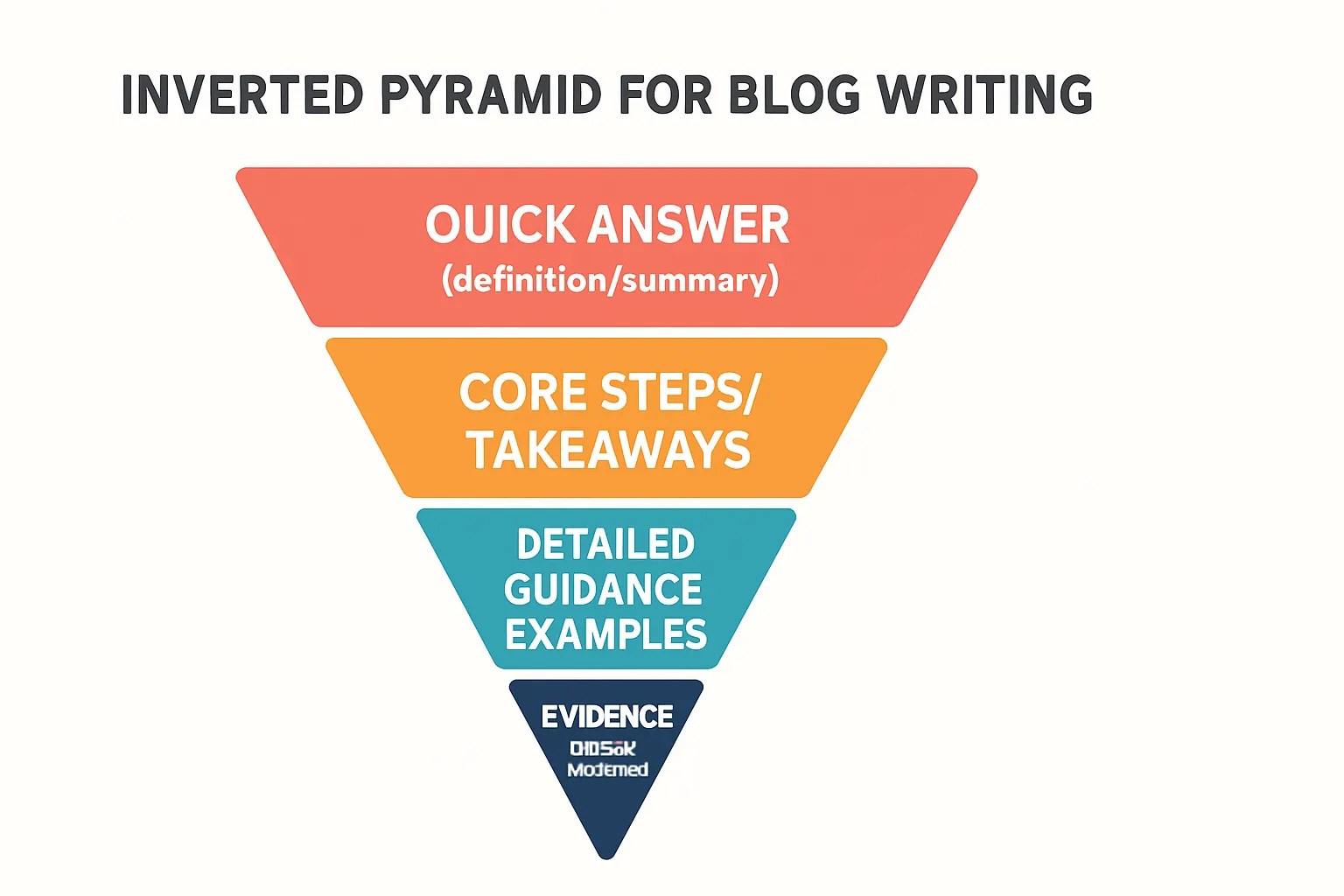
Use the inverted pyramid for clarity: quick answer → essentials → deep details → proof
Quick answer: Start with a 1–2 sentence definition or summary that satisfies immediate intent.
Core steps/takeaways: Present the main actions or key points (often as numbered steps).
Detailed guidance/examples: Expand with walkthroughs, screenshots, templates, or use cases.
Evidence: Support claims with data, citations, quotes, or benchmarks to boost E-E-A-T.
This structure maximizes skim-ability and helps AI Overviews and LLMs lift clean, accurate snippets.
Micro-structure that boosts readability: H2/H3 hierarchy, jump links, bullets, pull-quotes
H2/H3 hierarchy: Keep one idea per header; use parallel phrasing for siblings.
Jump links: Add an on-page TOC so readers can hop to sections.
Bullets and short paragraphs: Aim for 1–3 sentences per paragraph; convert sequences into lists.
Pull‑quotes and callouts: Highlight key definitions, steps, or warnings for scanners.
Consistent anchors: Use descriptive, keyword-relevant anchor text for internal links.
Visual cues: Use tables, diagrams, and checklists to compress complex info.
Post formats and when they win
Format | When It Wins | SERP Signals to Match |
|---|---|---|
How-To | Users need step-by-step instructions to complete a task | Numbered H2/H3 steps, “How to” title, HowTo/FAQ schema, checklist blocks |
Listicle | Users want curated options, ideas, or tools | Numbered list in H2s, “Best/Top” modifiers, scannable bullets, images/icons |
What-Is | Users seek a fast definition with essentials | Definition-first intro, concise summary box, key components table, FAQs |
Case Study | Readers need proof of outcomes and methodology | Results in headline, before/after visuals, metrics callouts, methodology section |
Survey | You have original data or trends to share | Charts/tables, methodology notes, stat callouts, year in title, downloadable asset |
X vs. Y | Buyers compare solutions or frameworks | Comparison table, pros/cons blocks, use-case guidance, decision checklist |
Beginner’s Guide | Newcomers need a clear, friendly starting point | Progressive H2/H3s, glossary, visuals, FAQs, step-by-step with simple language |
Build a writer-ready outline (H1–H4) with examples
A writer-ready outline removes guesswork. It tells your team exactly what to write, which examples to include, and where to place links and CTAs - so writing blog posts becomes faster, clearer, and easier to scale.
Draft a working title and H1 using B.R.A.V.E. (Brand, Recentness, Amount, Velocity, Economy)
Use B.R.A.V.E. to increase click-through and set clear expectations.
Brand: Add “BlogBowl” if brand trust helps.
Recentness: Include the year if freshness matters (e.g., 2025).
Amount: Use numbers for steps or tips.
Velocity: Promise speed (template, checklist, quick start).
Economy: Highlight savings or free resources if relevant.
Title options (mix and match the elements):
How to Write a Blog Post Outline in 9 Steps [2025 Guide]
BlogBowl: A Simple Blog Writing Outline Anyone Can Use (Free Template)
11 Outline Mistakes in Blog and Article Writing (and How to Fix Them Fast)
The Beginner’s Guide to Writing Blog Posts That Rank [Checklist + Examples]
Write a Blog Entry Outline in 20 Minutes (Proven Process)
H1 guidance:
Keep to one H1, mirror the title tag closely, and include the primary keyword (e.g., “blog post outline” or “blog writing outline”).
Make the promise explicit and human-first: what the reader will get and how fast.
Plan your H2/H3 flow to cover sub-intents, objections, and examples
Turn intent into a structured flow (H2s = main sub-intents; H3s = supporting answers, objections, proof).
Example H2/H3 map for a “blog writing outline” post:
H2: What Is a Blog Post Outline?
H3: Definition (1–2 sentences)
H3: Why It Matters for Rankings and Readers
H2: Steps to Create Your Outline
H3: Choose a Primary Keyword + Sub-Intents (PAA/AI Overviews)
H3: Pick the Best Format (How-to, List, What Is, Comparison)
H3: Map H2/H3s Using the Inverted Pyramid
H2: Add Evidence and Examples
H3: Data, Quotes, and Original Screenshots
H3: Mini Case Example (Before/After)
H2: Optimize as You Write
H3: Internal Links and Anchor Text
H3: Long-Tails and Semantic Coverage (without stuffing)
H2: FAQs
H3: Common Reader Questions (from PAA and support tickets)
Coverage checklist for best practices for blog writing:
Sub-intents addressed? (definitions, steps, examples, objections)
Comparison or alternatives included if expected by SERP?
Proof layered in (stats, screenshots, quotes)?
Clear CTA matched to reader stage?
Add notes below each heading: bullets for examples, stats, internal links, CTAs
Under every H2/H3, leave 3–6 bullets that make drafting a written blog frictionless:
[Example] Real scenario with metrics (e.g., “Outline reduced draft time by 40%”).
[Stat] One credible data point (source .gov/.edu/industry).
[Internal link] Suggest exact anchor text and target page (e.g., “blog structure guide”).
[External link] Authoritative definition or study (non-competitive).
[CTA] Align to funnel stage (download template, subscribe, start trial).
[Asset] Image/table/video to add (e.g., “insert inverted pyramid diagram”).
Sample “notes under heading” example:
H2: Steps to Create Your Outline
[Example] Show an outline before/after snippet.
[Stat] Include 1 metric about structured content and engagement.
[Internal link] Link “keyword research framework” to your guide.
[CTA] “Download the outline template.”
[Asset] Table of formats and when they win.
This is how content writing blog posts stays consistent across authors and deadlines.
Schema opportunities: HowTo and FAQ for rich results
HowTo schema:
Include name, description, step list (HowToStep), optional tools/supplies, estimated time/cost, and image for key steps.
Map steps to your numbered H2/H3s for maximum alignment.
FAQ schema:
Add 3–6 concise Q&As that mirror PAA and objections discovered in SERP analysis.
Keep answers short (2–4 sentences) with consistent terminology.
Pro tip: BlogBowl can auto-generate and inject HowTo/FAQ schema from your outline structure, increasing eligibility for rich results without manual code.
Deliverable: shareable outline checklist for content writing blog posts
Use this one-pager to make every blog entry writing project writer-ready:
Working title + H1 using B.R.A.V.E. (keyword included, intent clear).
Inverted pyramid plan (quick answer → essentials → deep details → proof).
H2/H3 hierarchy mapped to sub-intents, objections, and examples.
Notes under each heading: [Example], [Stat], [Internal link], [External link], [CTA], [Asset].
SERP fit: format matched, PAA integrated, AI Overview-ready definitions.
Internal linking plan with descriptive anchors (topic cluster alignment).
Evidence list compiled (sources + links ready to insert).
Schema targets set (HowTo, FAQ), plus media plan (image/table/video).
Final CTA aligned to reader stage (template, demo, signup, related guide).
Editorial specs: tone, target word range, voice notes, review owner, due dates.
When your outline checks these boxes, blog and article writing becomes a fill‑in‑the‑blanks exercise - fast, consistent, and primed to rank.
Research deeply and secure authority (E-E-A-T)
Great posts don’t just read well - they stand up to scrutiny. To earn trust (and rankings), combine rigorous sources with lived experience and crystal-clear citations right inside your outline.
"71.7% of content marketers use AI to help outline and brainstorm posts." - Source
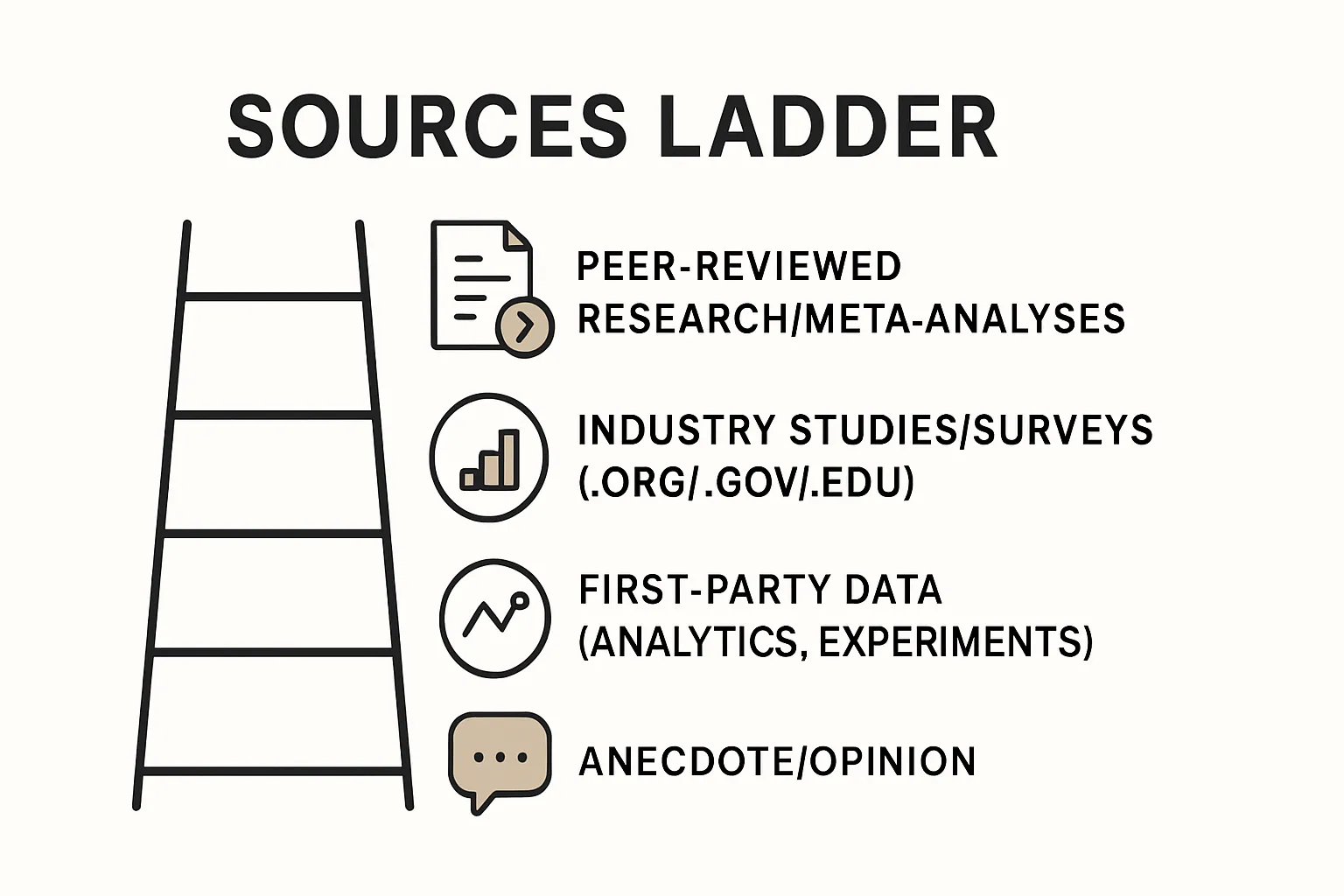
The sources ladder: first-party data, expert interviews, .gov/.edu/.org, reputable studies
Climb this ladder as you build authority in your written blog:
Anecdote/Opinion: Use sparingly and always pair with evidence.
First-party data: Analytics, cohort reports, surveys, tests, message testing.
Expert interviews: SMEs, customers, product teams - quote them with context.
Reputable orgs: .gov, .edu, .org, standards bodies, foundations.
Industry studies: Recognized vendors and journals with transparent methods.
Peer‑reviewed research/meta-analyses: Highest tier for claims that need strong proof.
Tip: Prefer the highest tier available; cite lower tiers to add color and narrative.
Use V.I.N.E.S. to find angles competitors miss (Video, Images, News, Experts, Social)
Video: Scan YouTube for step gaps and comments that surface real questions.
Images: Google Images reveals visual expectations - diagrams or process shots to include.
News: Use News search for fresh data, new reports, and timely angles.
Experts: Follow SMEs on LinkedIn/X, subscribe to niche newsletters, note quotable insights.
Social: Mine Reddit threads and communities for phrasing and objections to address.
Apply V.I.N.E.S. during outlining to design sections your competitors overlook.
Place evidence directly in the outline (bulleted stats/links per section)
Under each H2/H3, pre-load proof so drafting is fast and factual:
[Stat] 1 concise data point with link (source and year).
[Quote] Expert pull‑quote with attribution.
[Example] Short use case with metrics (before/after if possible).
[Asset] Table/diagram/video to visualize the point.
[Internal link] Anchor + target URL to your related post or doc.
[External link] Authoritative non‑competitive reference.
Example:
H2: Results from Structured Outlines
[Stat] “Posts with numbered steps increase completion by X%” (source).
[Example] Outline → 35% faster draft time across 8 posts.
[Internal] “Internal linking guide” as anchor to site cluster.
[Asset] Checklist table for QA.
Add lived experience and case examples to elevate trust
Show your work: Briefly explain your methods (how you collected data/interviewed SMEs).
Include mini-cases: Real screenshots or anonymized metrics from your product or clients.
Surface failure and iteration: What didn’t work and how you adjusted.
Map insights to actions: “Because we saw X, we changed Y” so readers can replicate.
When your outline embeds high‑quality sources and genuine experience, your final post signals Experience, Expertise, Authority, and Trustworthiness - exactly what readers (and search engines) reward.
Draft for humans, optimize for SEO (on-page essentials)
Write like a coach, not a textbook. Keep your language plain, your structure obvious, and your proof easy to find - then layer in search optimizations that help people (and crawlers) understand your post instantly.
"During an average visit, users read at most 28% of the words on a webpage; 20% is more likely." - Source
Clarity first: short paragraphs, active voice, front-load value, plain language
Short paragraphs: 1–3 sentences each; convert sequences into bullets/numbered steps.
Active voice: “Do X” beats “X should be done.”
Front‑load value: Lead with a one‑sentence definition or takeaway before details.
Plain language: Replace jargon with everyday words; define terms once.
Consistent headings: One idea per H2/H3; keep sibling headings parallel (same pattern).
Visual rhythm: Use tables, callouts, and images to break walls of text.
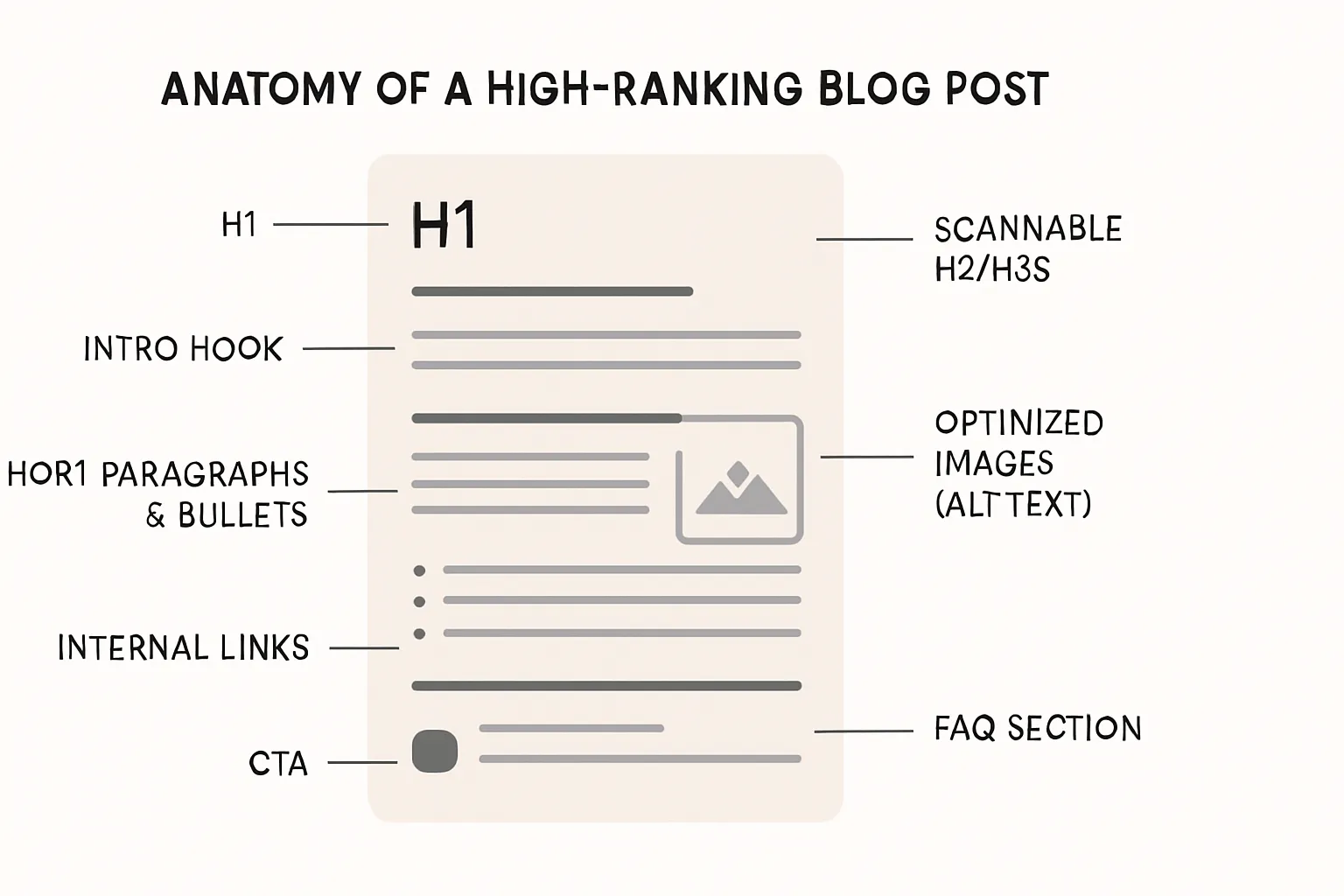
On-page SEO checklist: titles, meta descriptions, H2/H3s, alt text, anchor text, file names
Use this quick checklist as you draft and edit.
Element | Best Practice | Where to Place |
|---|---|---|
Title tag | Primary keyword early, under ~60 chars, add hook/year if relevant | Title tag |
H1 | One per page, mirrors title naturally, human-first promise | H1 |
H2/H3 | Descriptive, intent-matching, use secondary/semantic terms naturally | H2/H3 |
Intro | Hook + 1–2 sentence definition or summary; set expectations fast | Intro |
Definition box | Add a crisp, scannable definition near the top | Intro |
Numbered steps | Lead steps with verbs; keep steps parallel for snippets | H2/H3 |
FAQ items | 3–6 concise Q&A that map to PAA and objections | H2/H3 |
Internal links | Descriptive anchors (not “click here”); support topic clusters | Internal anchor |
Images (alt + file name) | Descriptive alt text; hyphenated, descriptive file names (no “IMG_123”) | Alt text |
Meta description | 150–160 chars, benefit + CTA, include primary term once | Meta |
Rich elements that boost UX: tables, numbered steps, diagrams; accessibility + performance
Tables: Compare options, summarize steps, or present specs at a glance.
Numbered steps: Perfect for how‑tos; improves completion and snippet odds.
Diagrams: Visualize flows (e.g., inverted pyramid, decision trees).
Accessibility:
Alt text that describes purpose; avoid keyword stuffing.
Clear link text; maintain sufficient color contrast and readable font sizes.
Use headings in logical order (no skipping levels for styling).
Performance:
Compress images (WebP/AVIF), lazy‑load noncritical media, serve responsive sizes.
Limit heavy embeds; replace with screenshots + links when possible.
Schema + snippet wins: lead with crisp definitions, numbered lists, and FAQs
Lead with a definition: 1–2 sentences that cleanly answer the core query.
Use numbered lists for processes (HowTo-friendly) and bullet lists for takeaways.
Add concise FAQs drawn from People Also Ask and support tickets.
Schema targets:
HowTo schema for step‑based guides (name, steps, images, time).
FAQ schema for your Q&A block (3–6 questions).
Formatting for AI Overviews/LLMs: Short, unambiguous headers; definition‑first sections; consistent terminology.
On BlogBowl, your drafts benefit from SEO‑optimized templates, automated internal linking, image optimization, and structured data recommendations - so you can write for humans while the platform helps you check the technical boxes.
Link smart, think multimedia, and design for UX
Thoughtful linking and lightweight multimedia make your content easier to navigate, faster to understand, and more likely to rank. Design for readers first - then fine-tune for crawlers and AI systems that summarize your work.
Internal linking: topic clusters, hub-and-spoke paths, next-step anchors
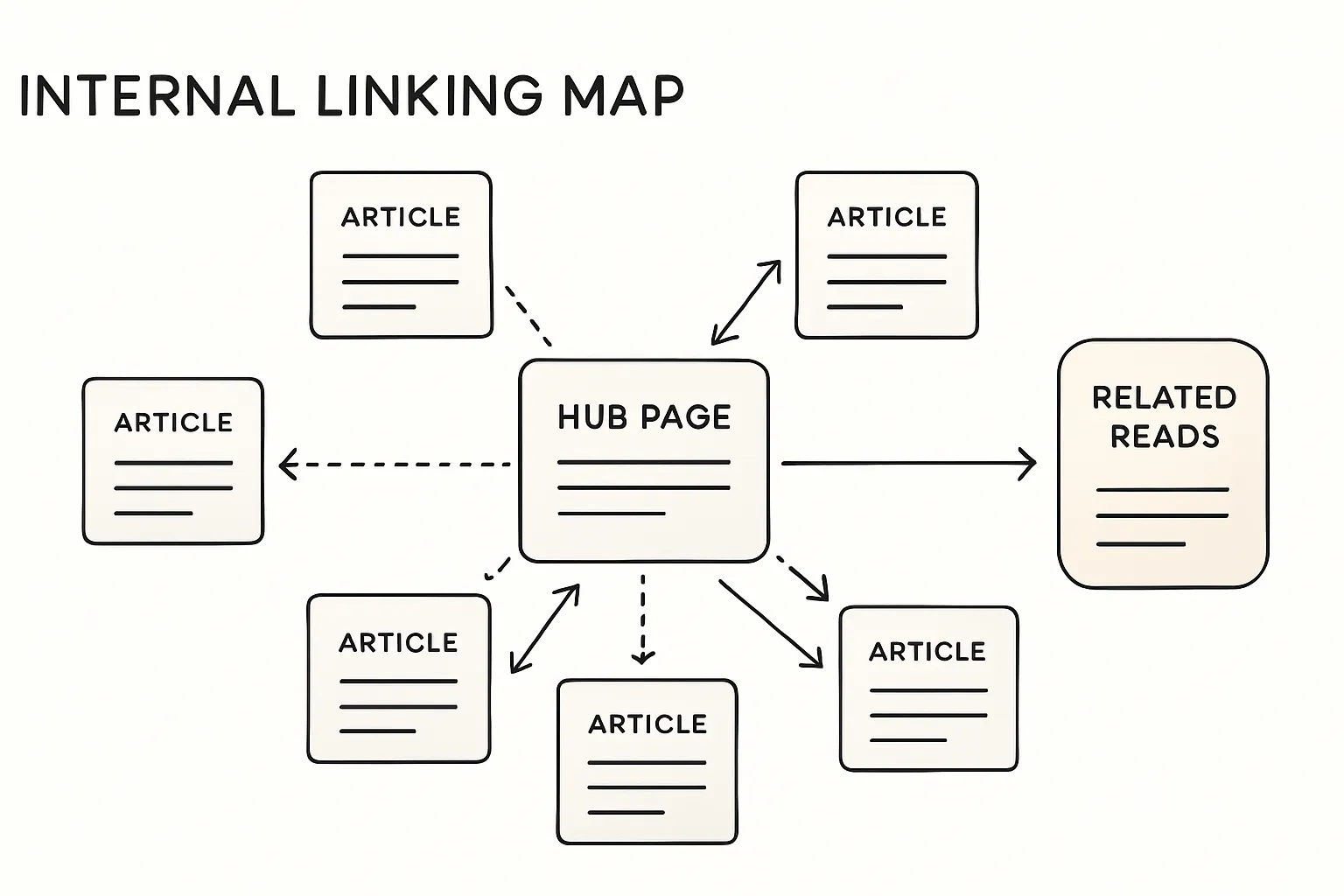
Build clusters: Create a hub page for the pillar topic and spoke posts for subtopics.
Orchestrate paths: Each spoke links back to the hub and sideways to sibling posts (contextual in-line links).
Prioritize next-step anchors: Use descriptive, action-led anchors (e.g., “outline your H2/H3s” vs. “click here”).
Surface related reads: Add a sidebar or end-of-post module that keeps readers in the cluster.
Refresh links: When you publish a new spoke, update the hub and older siblings to maintain a tight web.
BlogBowl tip: Our internal linking automation suggests anchor text and cross-links that reinforce your topic map at scale.
External linking: credibility, context, and building topical authority
Cite authority: Link to .gov/.edu/.org, standards bodies, and reputable industry studies.
Add context: Use external links to define terms, support claims, or offer neutral benchmarks.
Open in new tab: Preserve session while giving readers depth.
Support your stance: Contrasting viewpoints can strengthen your argument - acknowledge and explain.
Consistent attribution: Name the source in text when the brand adds credibility.
Multimedia: when to embed video, diagrams, or tools without slowing pages
Choose the right format:
Video for workflows and demos.
Diagrams for processes and frameworks.
Interactive tools for calculators, estimators, or checklists.
Optimize for speed:
Lazy-load embeds, defer third-party scripts, and cap initial requests.
Use WebP/AVIF images with responsive sizes; compress aggressively.
Prefer screenshots + link instead of heavy embeds when performance matters.
Accessibility: Provide captions/transcripts, alt text, and keyboard-friendly controls.
Voice- and AI-friendly structure: short definitions, Q&A blocks, descriptive alt text
Definition-first: Start key sections with a crisp 1–2 sentence answer.
Q&A blocks: Add short FAQs that mirror People Also Ask and support tickets.
Descriptive alt text: Explain image purpose; avoid stuffing keywords.
Clear headings: Consistent H2/H3 phrasing helps both scanners and LLMs.
Stable terminology: Use the same term for the same concept across the post and cluster.
Design your content like a product: intuitive paths, fast responses, and helpful context. BlogBowl’s SEO templates, media optimization, and automated internal linking make that experience repeatable across every post.
Mini walk-through: From outline to publish in 7 steps
Turn any idea into a published, ranking article with this fast, repeatable framework. Use it for blog writing sprints, team handoffs, and scale-up content calendars.
Step 1 - Define your goal and reader (pain → outcome)
Goal: traffic, signups, backlinks, or feature adoption? Pick one primary.
Reader: role, stage, and pain. What problem are they trying to solve today?
Outcome: what success looks like (e.g., “Find a simple blog post outline they can use in 20 minutes”).
One-liner: “Help [persona] achieve [outcome] without [common barrier].”
Step 2 - Primary + secondary keywords; write an intent statement
Pick a primary keyword you can win; add long-tail and semantic terms.
Validate SERP: top formats, PAA questions, content gaps, AI Overview patterns.
Intent statement: “This post helps [persona] do [job] by [format], targeting [primary KW], covering [sub-intents], and answering [PAA].”
Step 3 - Pick format and map the inverted pyramid outline
Match format to intent: how-to, list, “what is,” comparison, case study, beginner’s guide.
Map the inverted pyramid:
Quick answer (definition/summary)
Core steps/takeaways (numbered)
Detailed guidance/examples
Evidence (data, citations)
Draft H2/H3s with parallel, scannable phrasing.
Step 4 - Add notes (examples, stats, internal links, visuals, CTAs)
Under each H2/H3, add 3–6 bullets so drafting a written blog is plug-and-play:
[Example] Real scenario, metric, or screenshot.
[Stat] One concise data point (year + link).
[Internal] Anchor text + target URL in your topic cluster.
[External] Neutral, reputable reference.
[Asset] Table/diagram/video to add.
[CTA] Match reader stage (template, demo, related guide).
Step 5 - Draft fast; optimize headings, snippets, and alt text as you go
Write in short paragraphs (1–3 sentences); convert sequences into bullets.
Lead sections with 1–2 sentence definitions or takeaways.
Tune headings to reflect intent and keywords naturally (no stuffing).
Add descriptive alt text and compressed, responsive images.
Place internal links with clear, benefit-led anchors.
Step 6 - QA for UX (readability, links, performance) and add schema (HowTo/FAQ)
Readability: grade level, active voice, scannable H2/H3 hierarchy.
Links: verify internal and external targets; fix orphan pages in your cluster.
Performance: compress images (WebP/AVIF), lazy-load embeds, test Core Web Vitals.
Schema: add HowTo (steps, images, time) and FAQ (3–6 concise Q&As).
Step 7 - Publish, distribute (newsletter, social, partners), and request backlinks
Publish: double-check title tag, meta description, and canonical.
Distribute: newsletter, social threads, community posts, and repurpose (slides, short video).
Outreach: share with quoted experts, partners, and publications; request relevant backlinks.
Iterate: monitor Search Console queries, add FAQs, expand sections that gain impressions.
Pro tip: On BlogBowl, this 7-step flow is built into our SEO-ready templates with automated internal linking, keyword clustering, and media optimization - so writing blog posts becomes a predictable, high-quality process from outline to publish.
Measure, learn, and refresh to keep ranking
Publishing is step one. Staying visible means instrumenting your content, learning from behavior, and refreshing with purpose. Treat every post like a product: measure usage, improve UX, and ship updates.
KPIs: rankings, CTR, scroll depth, time on page, conversions, newsletter signups
Track a small set of KPIs tied to your goal:
Rankings: average position for the primary and top supporting keywords (Search Console).
CTR: impressions → clicks by query and page; benchmark against position (improve titles/meta/H1s).
Scroll depth: % of readers reaching key sections (e.g., 25/50/75/100%).
Time on page: differentiate scanners vs. engaged readers; watch median.
Conversions: demo/trial clicks, template downloads, contact requests (event tracking).
Newsletter signups: assist value for future distribution; segment by post/cluster.
Assist metrics: internal clicks to hub pages, related reads engagement.
Optional (advanced): featured snippet presence, AI Overview citations, link acquisition velocity.
BlogBowl tip: Our built-in analytics surface scroll depth, internal link assists, and CTR anomalies across your topic clusters.
Use analytics + heatmaps to spot friction; A/B test titles, intros, CTAs
Turn data into fixes:
Low CTR with good rankings: test title tag, meta description, and H1 alignment. Add clarity, recentness (year), and numbers.
High bounce + shallow scroll: tighten the intro, add a definition up top, insert a jump table, compress hero media.
Drop-offs before key section: move the section higher, add a scannable checklist, break dense paragraphs into bullets.
Weak internal link engagement: rewrite anchor text to promise value; add “next steps” boxes.
CTA blindness: make the CTA contextual (match section intent), simplify copy, and test placement (mid-post vs. end).
A/B test ideas (run 1 change at a time, measure 2–4 weeks):
Title/meta variations (clarity vs. curiosity vs. recency).
First 100 words (definition-first vs. story-first).
CTA copy/placement (tool/template vs. demo vs. related guide).
Visual treatment (diagram vs. step table).
Refresh cadence: new data, better examples, internal link updates, pruning/consolidation
Adopt a predictable refresh rhythm:
30–45 days post-publish: add emerging queries from Search Console (FAQs, clarifications).
Quarterly: update stats, screenshots, year markers; upgrade examples to recent, specific, and SaaS-relevant.
Twice yearly: reassess SERP intent/format; add or remove sections to match winners; strengthen H2/H3s.
Ongoing: update internal links when you publish new spokes; fix orphan posts; add hub links where missing.
Prune or consolidate when:
Cannibalization exists (two posts rank for the same query) → merge into the stronger URL, 301 redirect.
No impressions/clicks for 6–9 months and no strategic value → update or retire; redirect to the closest match.
Thin/duplicative content → expand with real examples, data, and clearer structure - or consolidate.
BlogBowl automates internal linking suggestions and flags posts with decaying impressions so you refresh the right assets first.
Document wins and feed insights back into future blog writing
Close the loop so every written blog gets better:
Maintain a content changelog: date, hypothesis, change, KPI impact.
Snapshot SERP fit: which formats, headers, and elements correlate with gains (e.g., definition boxes, numbered steps, FAQs).
Record voice-of-customer: questions from support/sales/comments - turn them into H3s or new posts.
Create a “Best Practices” playbook: title patterns that lift CTR, intro frameworks that reduce bounce, CTA phrasing that converts.
Share refresh outcomes with your team: turn wins into checklists for blog entry writing and templates inside your CMS.
Pro tip: With BlogBowl’s analytics + automation, you can identify which posts to refresh next, push internal link updates across clusters, and roll insights into your SEO-optimized templates - keeping your blog and article writing pipeline compounding month after month.
Conclusion and next steps: Launch and scale with BlogBowl
Recap: research → outline → draft → on-page → linking → measure → refresh
Research: start with reader pains and search intent; choose a primary keyword plus long-tails and semantics.
Outline: match the format to intent and map an inverted pyramid (quick answer → essentials → details → proof).
Draft: keep paragraphs short, lead with definitions, and write in plain language.
On-page essentials: optimize titles, H2/H3s, alt text, anchor text, and meta; add tables, steps, and diagrams.
Linking: build hub-and-spoke internal links; cite authoritative external sources.
Measure: track rankings, CTR, scroll depth, time on page, conversions, and signups.
Refresh: add new data, improve examples, update internal links, and consolidate where needed.
This is the repeatable system for writing blog posts that rank and convert - without guesswork.
How BlogBowl accelerates this workflow: AI keyword research, daily SEO-optimized posts, automatic internal linking, embedded media, and analytics - all code-free
AI keyword research and clustering: discover opportunities and sub-intents in seconds.
Daily SEO-optimized posts: publish consistent, people-first content without bottlenecks.
Automatic internal linking: hub-and-spoke connections and descriptive anchors - at scale.
Embedded media, automatically: AI-generated images, diagrams, and helpful videos built in.
Built-in analytics: see scroll depth, internal link assists, CTR anomalies, and decaying pages.
Code-free templates: fast, accessible, and SEO-optimized layouts tuned for Google and AI Overviews.
Multi-blog, multi-author: invite your team, assign roles, and keep a clean editorial pipeline.
Domain integration: connect your custom domain and ship a professional, fast blog in minutes.
With BlogBowl, blog and article writing becomes a reliable growth engine - your team focuses on expertise while the platform handles the heavy SEO lifting.
CTA: Launch a fast, SEO-optimized blog in under 60 seconds with BlogBowl. Connect your domain, invite authors, ship consistently - and grow traffic on autopilot.
Ready to turn this framework into results? Launch your BlogBowl site, generate your first outline, and publish your first post today - no code, no plugins, no setup headaches.