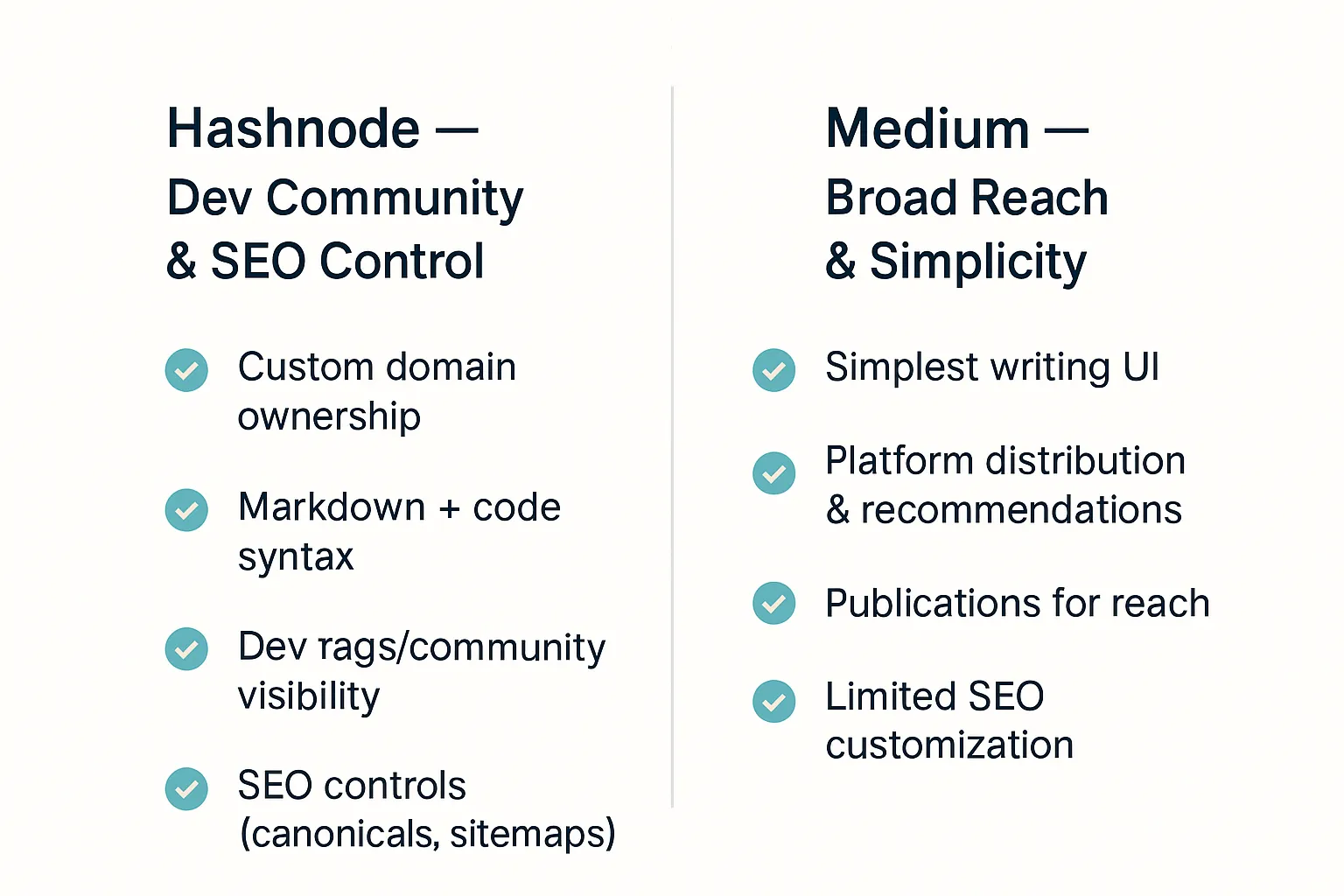
Introduction + Hashnode vs Medium at a glance
Developer blogging in 2025 is more than publishing thoughts - it’s a strategic lever for career growth, product visibility, and community credibility. For engineers and SaaS teams, choosing the right platform impacts ownership (your domain and data), SEO (how discoverable your posts are in Google and AI search), and reach (built-in audience and distribution). That’s why the Hashnode vs Medium decision matters: each platform approaches developer blogging very differently.
Hashnode primarily serves developers and engineering teams. It’s purpose-built for technical content with Markdown, code blocks, GitHub syncing, custom domains, and strong SEO foundations. Medium, on the other hand, serves a broad audience. It’s excellent for thought leadership and reach across many topics, with a clean writing experience and platform-driven distribution - but with limited SEO control and customization compared to developer-first tools.
If you’re a SaaS team that wants a fully managed, SEO-first blog with AI automation, BlogBowl can be a better fit than either community platform. You’ll get fast, SEO-optimized templates, automatic content generation, built-in newsletters and analytics, and multi-blog management - so you can focus on shipping content while we handle the heavy lifting.
Key area | Hashnode | Medium |
|---|---|---|
Audience | Developers, engineering teams, OSS communities | General readership across topics; thought leadership and essays |
SEO control | Strong technical SEO (clean URLs, sitemaps, canonical tags), performance-first hosting | Limited SEO controls; relies on platform authority and internal distribution |
Custom domain | Yes - custom domains and sub-paths supported | Publishes on Medium subdomains; custom domains available for publications (platform-managed) |
Editor | Block-based WYSIWYG Markdown with code syntax highlighting | Minimalist, distraction-free editor with code blocks |
Integrations | GitHub sync, headless CMS options, team collaboration, AI-assisted writing | Limited third-party integrations; built-in distribution and Partner Program |
Pricing/Monetization | Free platform; monetization typically via sponsorships/affiliates or external channels | Free to write; monetization via Partner Program tied to reader engagement/subscription ecosystem |
What you’ll learn in this guide:
When Hashnode’s developer-first stack beats Medium’s distribution - and when Medium’s reach is the smarter play
How SEO, ownership, and customization differ between the two
Which platform fits solo devs vs. SaaS teams
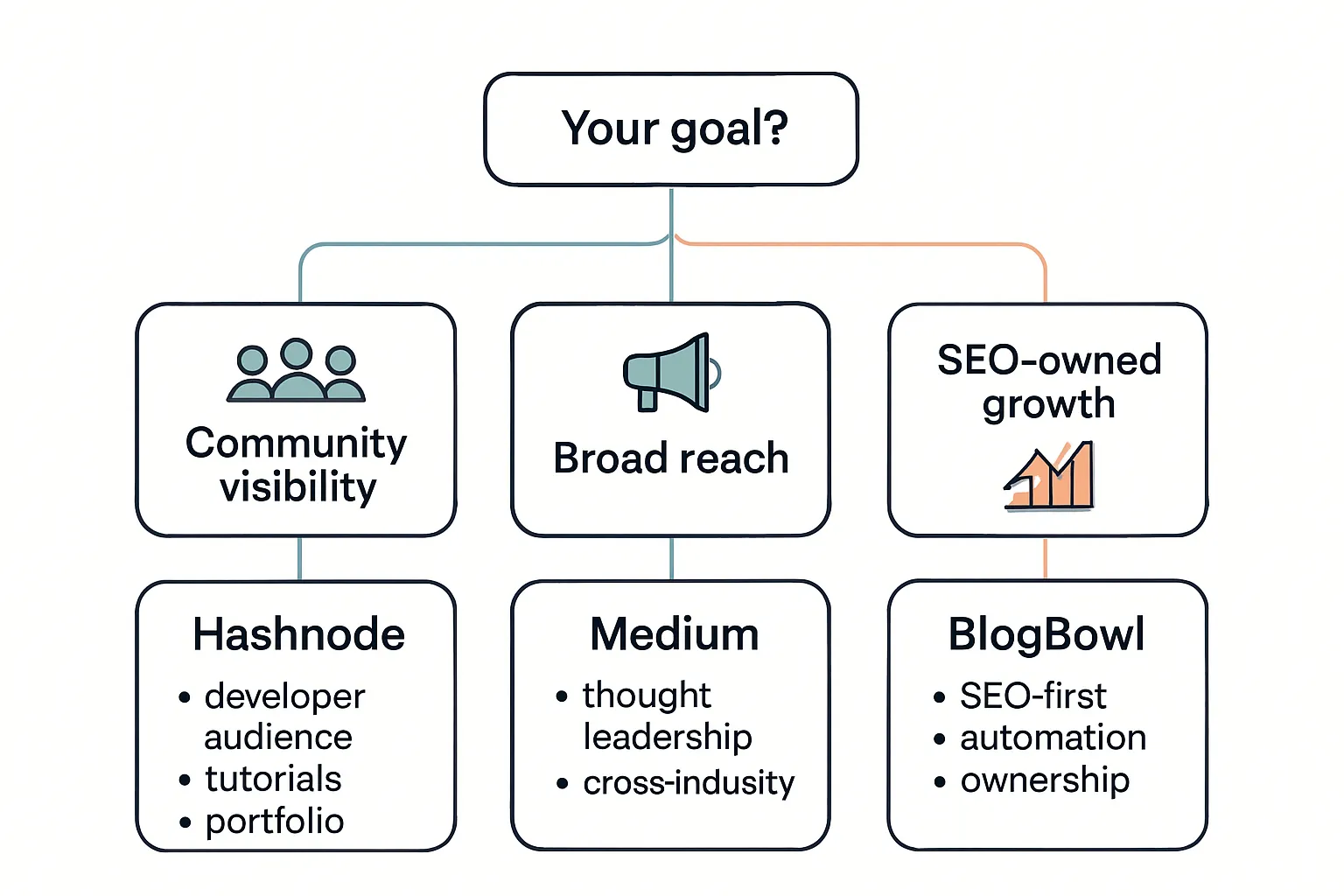
A fast decision path: pick Hashnode for technical control and dev community; pick Medium for reach and simplicity; choose BlogBowl if you want an SEO-first, automated, fully managed blog for your SaaS content pipeline
Who each platform is for (use cases and decision guide)
Hashnode best fits:
Developer portfolio and engineering blog under your own domain
Tutorials, code snippets, and deep technical write-ups
Learn-in-public knowledge sharing with peers
Community visibility within a developer-first network
Medium best fits:
Thought leadership and essays for a broader audience
Cross-industry readership beyond pure engineering
Credibility-building for managers, founders, and PMs
Simple publishing with platform-driven distribution
Trade-offs to consider:
Discovery vs. control: Medium’s algorithm can surface posts quickly, while Hashnode gives you greater ownership (custom domain, SEO structure).
Community vs. distribution: Hashnode offers dev-centric community engagement; Medium offers wider general distribution with less technical focus.
Quick decision by goal:
Learn-in-public: Hashnode
Hire-me portfolio: Hashnode (custom domain + technical credibility)
SEO compounding: Hashnode or BlogBowl (for full SEO ownership and scaling)
Newsletter-first: Medium works, but consider BlogBowl for integrated newsletters + SEO
Brand building: Medium for reach; Hashnode for technical brand depth; BlogBowl for owned, scalable SEO and automation
Brief note on BlogBowl:
If SEO ownership, speed, and automation are your top priorities (especially for SaaS teams), BlogBowl delivers a business-grade, fully managed, SEO-first blog with AI-assisted content and built-in analytics/newsletters - ideal when you need predictable, compounding organic growth without extra tooling.
Writing experience and developer tooling
Editor feel:
Hashnode: Markdown-first with a block-based WYSIWYG layer, autosave drafts, version history, and real-time collaboration for teams.
Medium: Minimalist rich-text editor, smooth inline formatting, autosave drafts; collaboration via “edit access” and inline suggestions for publications.
Developer niceties:
Hashnode: Native code blocks with syntax highlighting, Markdown tables, and easy embeds for GitHub repos/gists and interactive sandboxes.
Medium: Clean code blocks for readability; supports basic embeds (tweets, videos, and select third-party content) but fewer developer-specific integrations.
Content organization:
Hashnode: Tags, series, and team publications; supports custom domains/sub-paths and structured navigation that suits engineering blogs and docs.
Medium: Tags and publications with algorithmic distribution; series and collections for narrative content, geared toward broad readership.
Accessibility and formatting controls:
Hashnode: Precise control over headings, alt text for images, link titles, and semantic structure out of the box for technical SEO.
Medium: Strong typography and accessible defaults; simpler controls for alt text and headings compared to developer-first platforms.
Learning curve and speed to publish:
Hashnode: Very fast for devs comfortable with Markdown; short learning curve for WYSIWYG users; excellent for technical posts with code.
Medium: Fastest path for general writing; little setup, ideal for essays and thought leadership without heavy formatting.
SEO, content ownership, and domain control
SEO basics (Hashnode vs Medium):
Titles and meta descriptions: Both support clean titles and descriptions; Hashnode gives more granular control at the post and site level for technical SEO.
Canonical URLs: Hashnode supports canonicals to your root site when syndicating; Medium supports canonical links when republishing to avoid duplicate content.
Sitemaps and robots: Hashnode generates sitemaps and respects robots directives; Medium manages indexing centrally with less per-site configurability.
Open Graph (OG) tags: Hashnode lets you fine-tune social previews; Medium auto-generates consistent previews with fewer customization levers.
Custom domain and ownership:
Hashnode: Map a custom domain or sub-path for full brand ownership, keeping link equity on your own URL.
Medium: You publish within Medium’s ecosystem. Publications can use platform-managed custom domains, but posts primarily live under Medium’s structure.
"Hashnode supports custom domains and subdomains: use an A record to 76.76.21.21 for apex, or CNAME to hashnode.network for subdomains." - Source
Content portability and syndication:
Exports: Hashnode makes it straightforward to export posts for backup or migration; Medium offers content export for your stories.
Canonicals back to your site: Hashnode’s canonical support makes it easy to syndicate while preserving SEO on your domain; Medium allows setting a canonical to your original URL when republishing.
Workflows: A common approach is publishing on your owned domain (or Hashnode with custom domain) and syndicating to Medium with a canonical for reach.
Indexing speed and discoverability:
Hashnode: Fast-loading pages and clean technical structure help quick indexing; discoverability comes from dev tags, community feeds, and Google search.
Medium: Strong internal distribution and platform authority can accelerate early impressions, but you sacrifice granular on-page control.
"Medium reports approximately 100 million monthly readers." - Source
Long-term compounding and brand equity:
Hashnode with a custom domain compounds SEO under your brand, building topical authority and link equity you fully own.
Medium compounds within Medium’s ecosystem; it’s excellent for short-term reach and brand awareness, but less ideal for accruing SEO value to your own domain.
Quick note for businesses and SaaS teams:
BlogBowl provides SEO-first templates, privacy-friendly analytics, and automatic internal linking to compound rankings over time. With AI-assisted content and built-in newsletters, it’s a strong choice when you need owned search growth and automation without extra setup.
Distribution and audience reach
Hashnode’s dev-first network:
Tags, developer-centric feeds, and an engaged technical audience help early traction for tutorials, explainers, and “learn-in-public” posts.
Network effects come from cross-posts, featured collections, and the platform’s integration with developer communities, which improves relevance and peer discovery.
Medium’s recommendation engine and publications:
Recommendation signals (reads, highlights, and follows) push stories into topic feeds and reader homepages.
Publications act as distribution hubs for niche audiences, enabling editorial curation and expanded reach to their followers.
Medium’s domain authority aids external search visibility for well-structured stories.
Typical path to first 1,000 readers:
Hashnode: Publish consistently in relevant dev tags, participate in discussions, and share to GitHub/OSS communities; compounding discovery comes from tags and community features.
Medium: Submit to aligned publications, optimize titles and intros for engagement, and leverage topic tags; recommendation momentum plus publication followers can accelerate growth.
Engagement styles:
Hashnode: Comments, reactions, and developer-focused feedback loops foster deeper technical conversations.
Medium: Comments, highlights, follows, and publication subscriptions; strong for narrative essays and thought leadership.
Avoiding platform lock-in:
Publish on your owned domain first, then cross-post with a canonical URL back to the original.
Keep full-text backups and maintain a subscriber list (email) independent of any platform.
"Medium distributes stories via followers, publications, and recommendation systems; qualifying stories can receive broader General Distribution or even a Boost for greater reach." - Source
Monetization, pricing, and value
For developers choosing between Hashnode and Medium, the monetization question often comes down to control versus built-in distribution. Medium offers a native earnings path via the Partner Program tied to reader engagement. Hashnode takes an open approach: you own your domain and audience, then monetize through sponsorships, affiliates, or external membership tools - no native paywall, but full flexibility and brand ownership.
Medium Partner Program:
How it works: You join the Partner Program and publish stories eligible for earnings. Revenue is influenced by engaged reading time from Medium members, quality signals, and distribution (e.g., recommendations or publication placement).
Who qualifies: Writers who comply with platform policies and set up payouts. Earnings generally require member readership; non-member traffic doesn’t drive payouts.
What influences earnings: Story quality, completion rate, topic appetite, publication features, and platform distribution (e.g., Boost/recommendations). Headlines, intros, and topic fit matter for momentum.
Hashnode monetization routes (no native paywall):
Sponsorships: Add a sponsor/“Work with me” page and partner with dev tools, cloud vendors, or training platforms.
Affiliate links: Review tools or write tutorials with relevant affiliate disclosures.
External memberships: Use third-party platforms (e.g., memberships or courses) and link from your posts.
Consulting and lead generation: Use your blog as a portfolio to drive inbound leads for engineering, audits, or training.
Newsletter options:
Medium: Built-in email distribution to followers; you can publish a newsletter-style cadence directly from your profile/publication.
Hashnode: Native opt-in components to collect subscribers; commonly used with third-party email tools for campaigns, digests, and automations.
Total cost of ownership (TCO):
Medium: Free to write; potential earnings via Partner Program; time investment goes into consistent publishing and optimizing for recommendations. Limited need for extra tools unless you add analytics or design assets.
Hashnode: Free to run with a custom domain available; you may add costs for domain registration, email service providers, analytics, or design tools. Time investment goes into SEO, sponsorship outreach, and building an owned audience.
Platform | Pricing to publish | Monetization model | Newsletter | Typical extras | Predictability/Control |
|---|---|---|---|---|---|
Hashnode | Free (domain registration optional) | Sponsorships, affiliates, external memberships, consulting leads | Opt-in on-site; integrate with email tools for sends | Email service, domain, analytics, design assets | High control over brand and SEO; revenue depends on your funnel |
Medium | Free to publish; earnings via Partner Program | Partner Program (member reading time, recommendations, publications) | Native newsletters to followers | Optional design/analytics tools | Less control over SEO/brand; earnings tied to platform distribution |
If you’re a SaaS team aiming for predictable, compounding organic growth with minimal overhead, BlogBowl offers a business-grade alternative: SEO-first templates, built-in analytics and newsletters, and AI automation that accelerates content production - so your monetization comes from owned traffic, not platform algorithms.
Integrations, analytics, and workflow ops
Analytics depth:
Medium: Built-in stats show views, reads, read ratio, and audience sources at a glance. For writers using the Partner Program, member reading time becomes a key signal. Great for quick performance checks, but limited export and customization.
Hashnode: Post-level insights plus seamless Google Analytics integration for deeper funnels, source/medium tracking, and conversion goals. Strong fit if you care about long-term SEO measurement and developer blogging performance across topics.
Integrations that matter:
Hashnode: GitHub integrations (including repo syncing for docs/blogs), native Markdown, code blocks with syntax highlighting, and common embeds (GitHub Gists, StackBlitz, CodePen, Loom). Easy to connect Google Analytics and newsletter tools.
Medium: One-click embeds for videos, tweets, and gists; basic integration footprint by design. You can augment with link tracking and UTM parameters, but platform-level integrations are intentionally minimal.
Collaboration and editorial workflows:
Hashnode: Team-friendly by default - inline comments, real-time editing, and publication-style collaboration. Good for engineering blogs and product documentation maintained by multiple contributors.
Medium: Publication roles (writers, editors) streamline submissions, editorial feedback, and scheduled publishing. Ideal for thought-leadership teams and cross-functional content programs.
Automation possibilities:
Hashnode: RSS feeds for syndication and notifications, plus straightforward Zapier/Make-style automations via RSS and webhooks. GitHub-based workflows help align releases/changelogs with content updates.
Medium: Import tool and RSS-driven notifications enable lightweight automation. Cross-posting often runs through canonical links and scheduling via publications; more advanced automation typically lives outside Medium.
Cross-posting and lock-in avoidance:
Publish first on your owned domain (or Hashnode with a custom domain), then cross-post to Medium with a canonical URL back to the original to preserve SEO.
Keep a single source of truth (repo or CMS), and use RSS/Zapier flows to distribute without duplicating manual effort.
Note for teams wanting an integrated stack:
BlogBowl combines built-in analytics, an integrated newsletter system, and AI-driven automation (topic research, internal linking, and daily drafts) so SaaS teams can run a full content pipeline without stitching together multiple tools.
Performance, reliability, and scalability
Page speed considerations:
CDN delivery: Both platforms rely on modern hosting and global content delivery to minimize latency. Hashnode emphasizes developer-grade performance, which helps heavy posts (with code snippets, images, and embeds) load quickly worldwide. Medium’s minimal front end and smart caching keep article pages fast and consistent.
Image handling: Both compress and lazy-load images. On Hashnode, image handling plus clean HTML improves Core Web Vitals for technical posts. Medium’s standardized templates and responsive images keep layout shifts low.
Code block performance: Hashnode’s syntax highlighting is optimized for developer readability and performance; it supports multi-language blocks without bloating the page. Medium’s code rendering is lightweight and readable but less customizable for advanced code UX.
Uptime and reliability (high-level):
As fully hosted platforms, both aim for high availability with autoscaling infrastructure, caching layers, and failover. Planned maintenance is rare, and incidents are typically short-lived, with quick recovery due to platform-level observability and SRE practices.
Scaling with your content library:
Hashnode: Tags, series, and team publications scale well for engineering libraries, with navigable archives and a structure that suits knowledge bases and tutorials.
Medium: Tags, topic feeds, and publications scale to large back catalogs. While personalization powers discovery, the taxonomy is less granular for technical libraries compared to dev-first platforms.
Mobile reading and accessibility:
Both deliver a high-quality mobile reading experience with responsive layouts and strong typography. Hashnode’s dev focus keeps code blocks scrollable and readable on smaller screens. Medium’s polished reading design, contrast, and spacing make long-form content comfortable on mobile. Both support alt text and semantic headings, though developer-first platforms offer finer control for technical SEO and accessibility.
Performance impact on SEO and engagement:
Faster pages improve Core Web Vitals (LCP, CLS, INP), which correlate with better rankings and higher completion rates. For technical content, efficient code highlighting, minimized scripts, and optimized images can reduce bounce and boost session depth. Over time, consistently fast delivery compounds - driving more impressions from search, longer reading sessions, and stronger conversion to follows, signups, or leads.
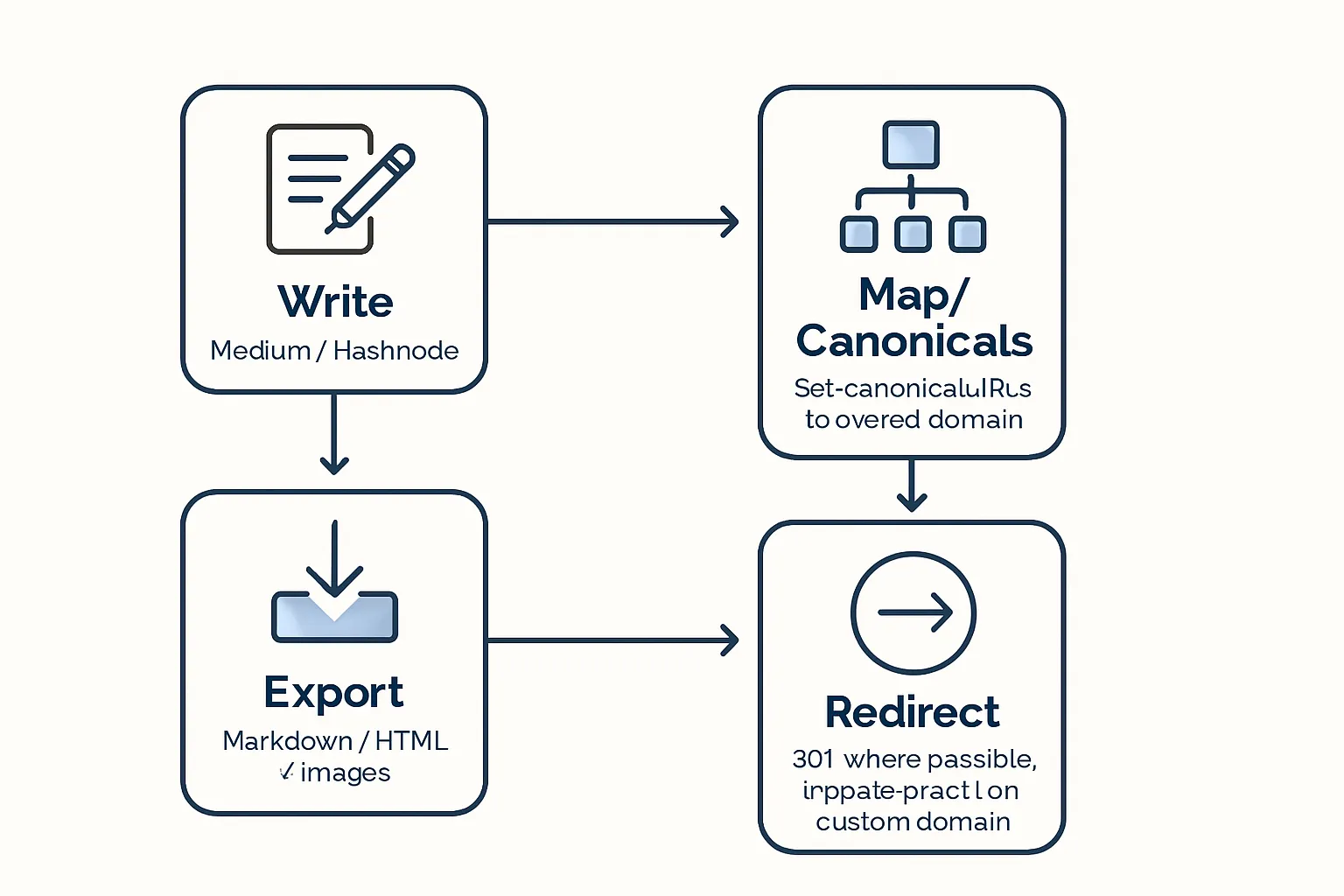
Migration and portability (start here, move later)
Export and import options:
Medium: Export stories and media from your settings; import to your own CMS or site. Use the “Import story” flow on platforms that support canonical setting.
Hashnode: Export posts (Markdown/JSON) and images; straightforward to import into most CMSs or static site generators.
Cross-posting strategy (preserve SEO):
Publish first on your owned domain, then cross-post to Hashnode or Medium with a canonical URL back to the original.
Maintain consistent titles, headings, and internal links to avoid creating divergent versions that split ranking signals.
Step-by-step moves:
Medium → personal site:
Export your stories and images.
Import to your CMS; set slugs close to original.
Set canonicals on Medium to your new URLs.
Rebuild internal links; verify indexing in Search Console.
Hashnode → personal site:
Export Markdown/JSON and media.
Import to your CMS or static site; keep structure/tags.
If using a custom domain on Hashnode, update DNS to your new host.
Add redirects from legacy paths to your new slugs.
Consolidate both → your own domain:
Audit inventory; pick canonical “home” URLs.
Import all posts; normalize categories/tags.
Map redirects (Medium can use canonical, Hashnode can use DNS + path redirects).
Update internal linking and resubmit sitemaps.
Migration checklist:
Maintain titles, meta descriptions, and H1s
Preserve image filenames/alt text; update image paths
Map 301 redirects for any URL changes
Add canonicals where redirects aren’t possible
Regenerate sitemap and submit to Search Console
Test a sample set in mobile and desktop, then roll out
Where BlogBowl fits:
When you’re ready to own your SEO assets and scale content, BlogBowl provides fast, SEO-first templates, automated internal linking, built-in analytics/newsletters, and AI-assisted content production - ideal for consolidating from community platforms while preserving ranking signals.
Final verdict: Which one should you choose?
Choose Hashnode if you want a developer-first community, custom domain ownership, and solid SEO control for long-term compounding traffic.
Choose Medium if you want the broadest cross-industry reach and the simplest, distraction-free writing experience.
Consider BlogBowl if you’re a SaaS team or business that prioritizes owned SEO growth, automatic publishing, integrated analytics/newsletters, and AI automation - so you can scale content without stitching together multiple tools.
Closing advice: Start publishing, measure what resonates, and iterate. You can always migrate later with exports, canonicals, and redirects to preserve your hard-earned momentum.