


Introduction: Smarter ChatGPT Prompts for Blog Posts (Outlines, Drafts, and Edits)
If you’ve tried ChatGPT for blog posts and got generic outputs, this guide fixes that. We’ll show you prompt frameworks that turn ChatGPT into a reliable co‑writer for idea generation, outlines, first drafts, and edits - without losing your brand voice, accuracy, or originality. And because BlogBowl automates SEO‑ready publishing, internal linking, and analytics, you’ll scale a consistent content engine across one or many ChatGPT blogs with less effort.
"Appropriate use of AI or automation is not against our guidelines. We focus on the quality of content, not how it’s produced." - Source
What you’ll learn in this guide
Prompt frameworks for ideas, outlines, first drafts, and edits
How to keep brand voice, accuracy, and originality
A repeatable workflow you can scale with AI and BlogBowl
Who this is for
SaaS teams, startups, and solo creators using ChatGPT for blogs
Marketers who need SEO-friendly, publishable drafts fast
Outcome
Leave with copy‑ready prompt recipes and a practical runbook to ship quality posts consistently - so you can spend less time writing blog content and more time growing traffic.
The modern blogging stack: ChatGPT + keyword intelligence + editorial judgment
The highest‑performing content teams pair ChatGPT for blog posts with smart keyword intelligence and human editorial judgment. ChatGPT accelerates ideation and drafting; keyword tools clarify search intent and structure; your expertise protects accuracy, nuance, and E‑E‑A‑T. With BlogBowl handling fast, SEO‑optimized publishing and internal linking, this stack turns writing blog content into a repeatable growth engine.
Why this stack wins
ChatGPT accelerates ideation and drafting
Keyword tools steer search intent and structure
Your editorial judgment ensures accuracy, nuance, E‑E‑A‑T
Quick setup checklist
Define target keyword cluster + search intent
Draft a brand voice card (tone, persona, do/don’t)
Create an editing checklist (facts, links, claims)
Watch: the workflow in action (1 video only)
Outline → brief → section drafts → polish → publish
"In-depth posts can take 7 hours and 35 minutes to produce." - Source
KPI goals to track
Time-to-first-draft, publish cadence, rankings, CTR, conversions
Prompt framework cheat sheet (outlines, drafts, edits)
Use these compact frameworks to get consistent, high‑quality outputs from ChatGPT. They’re tuned for writing blog content that’s on‑brand, accurate, and SEO‑ready.
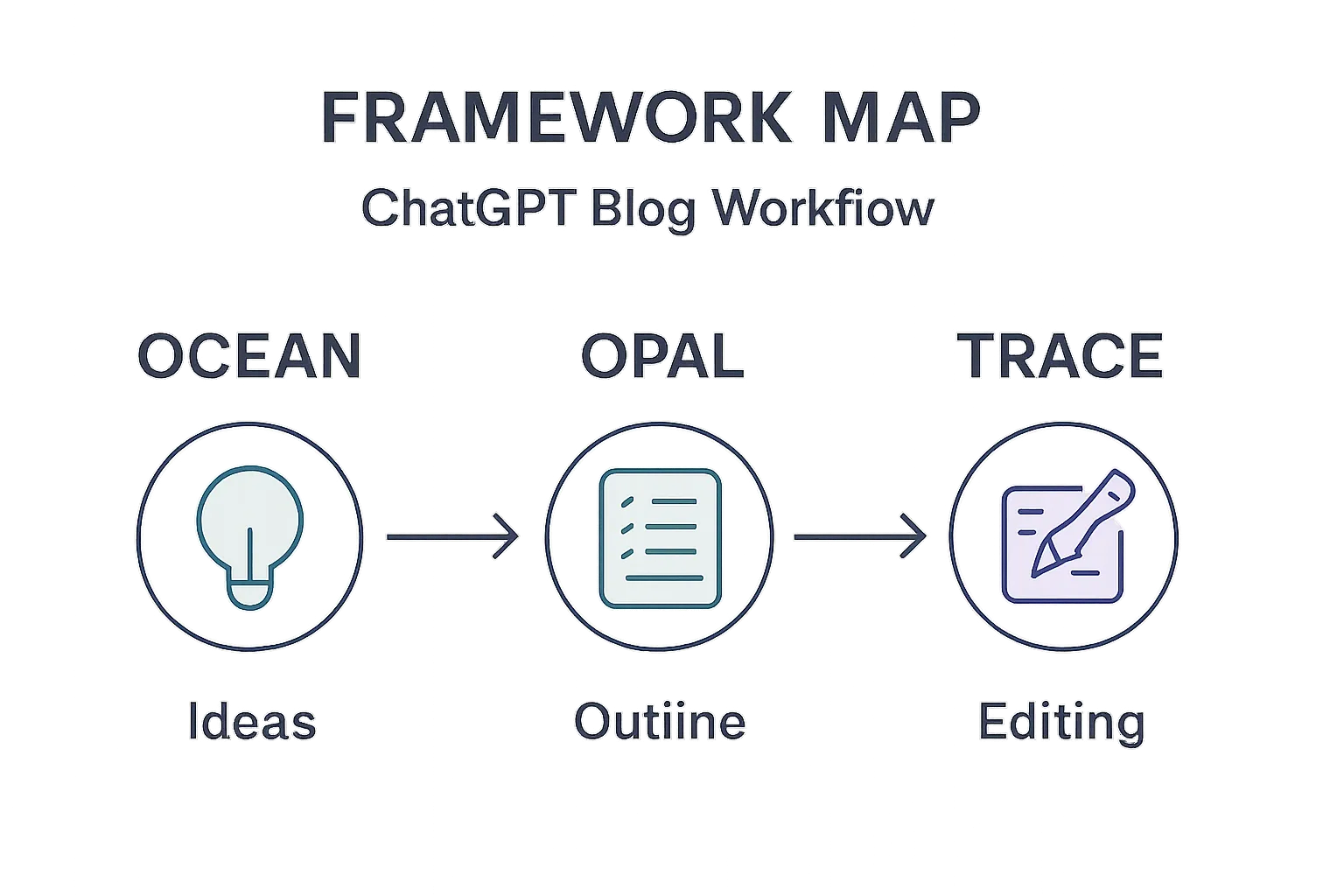
Frameworks at a glance
OCEAN for prompts: Objective, Context, Examples, Audience, Nuance/constraints
OPAL for outlines: Outcome, People (search intent), Angle, Landmarks (H2/H3)
TRACE for edits: Tone, Readability, Accuracy, Clarity, Evidence
How to pick the right framework
Outlines: OPAL → speed + coverage
Drafts: OCEAN → specificity + voice
Edits: TRACE → polish + credibility
Prompt Frameworks at a Glance
Use case | Framework (acronym) | What to include (variables) | Example one‑liner | Common pitfalls |
|---|---|---|---|---|
Topic ideation | OCEAN | Objective, audience, constraints (niche, difficulty), examples of winning posts | “Give 15 SaaS blog ideas for PLG startups; exclude generic listicles; include search intent.” | Too broad; ignores searcher intent |
Keyword-led outline | OPAL | Outcome, People (intent), Angle, Landmarks (H2/H3) | “Outline ‘Customer Onboarding Checklist’ for B2B SaaS (transactional); angle: time-to-value; include H2/H3s.” | Missing intent; vague section labels |
SEO brief | OPAL | Outcome, competitors, questions (PAA), must‑cover entities | “Create an SEO brief for ‘churn reduction’ incl. PAA, entities, internal links.” | Overstuffing keywords; no structure |
First draft | OCEAN | Goal, audience, brand voice, examples, constraints (word count, links) | “Draft 1,200 words in friendly/authoritative tone for PMs; cite 2 sources; include internal links.” | Generic tone; unsupported claims |
Section rewrites | OCEAN | Specific section goal, inputs, tone shift, constraints | “Rewrite this H2 for clarity and skimmability; keep examples; cap at 180 words.” | Losing key facts; padding fluff |
Editorial pass | TRACE | Tone, Readability, Accuracy, Clarity, Evidence checklist | “Apply TRACE: tighten sentences, fact‑check stats, add citations, fix passive voice.” | Polishing style but missing errors |
Fact checks & citations | TRACE | Claims list, sources to verify, add citations | “Verify stats in bullets; attach source links; flag outdated numbers.” | Uncited figures; dead links |
On‑page SEO | OPAL + TRACE | Outcome (SERP fit), intent match, internal links, meta | “Optimize headings for ‘how to’; add internal links; propose title/meta.” | Keyword stuffing; misleading titles |
From blank page to SEO‑ready outline (recipes you can paste)
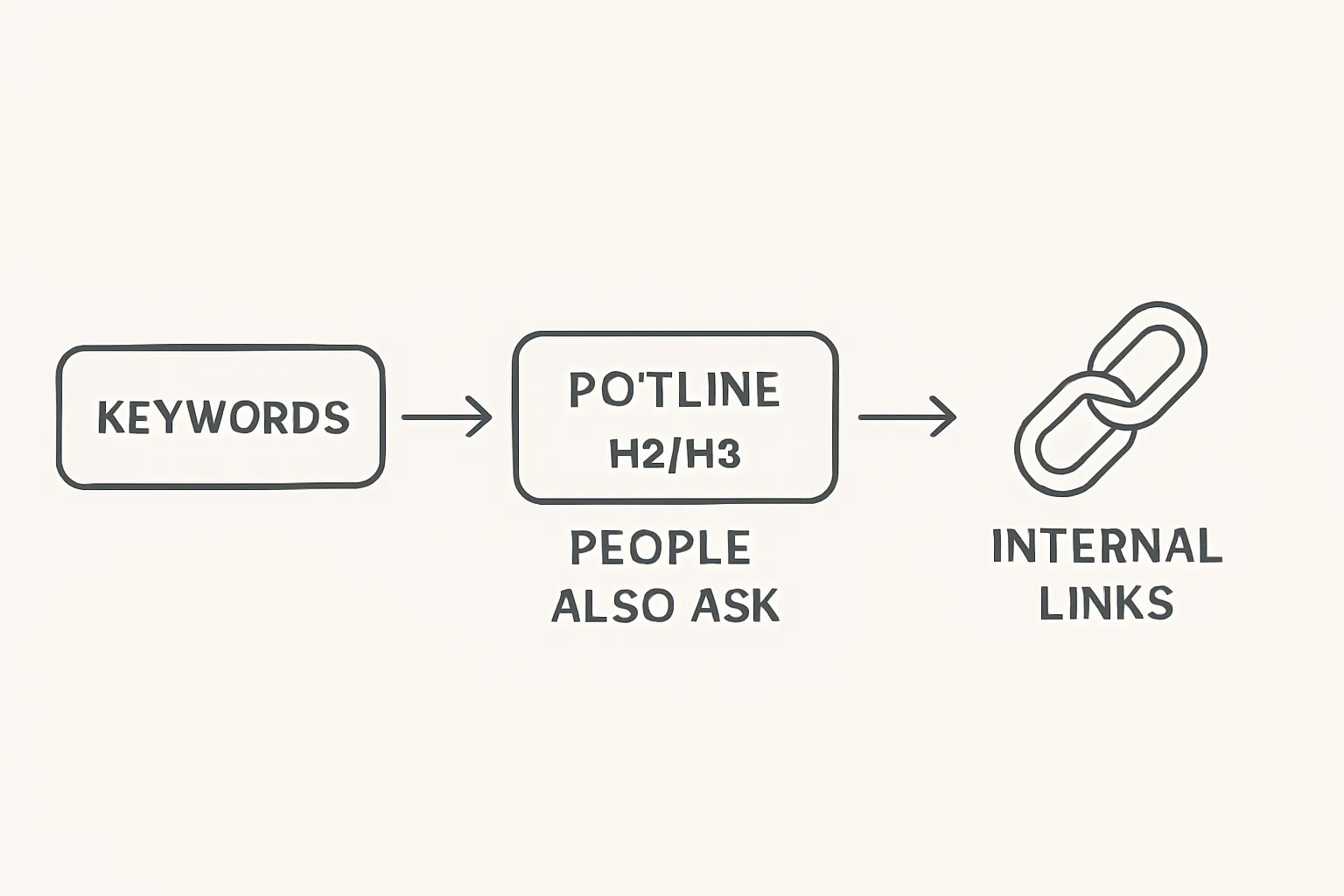
Turn raw keyword ideas into a publishable, SEO‑aligned outline with these copy‑ready prompts. They work for chatgpt for blogs and scale smoothly in BlogBowl.
Idea and angle prompts (chatgpt for blogs)
“Give me 12 angles for [topic] targeting [ICP] at [funnel stage], grouped by search intent.”
Keyword‑driven outline prompt (chatgpt for blog posts)
Paste this prompt into ChatGPT:
“Create an SEO outline for [working title]. Primary keyword: [PK]. Secondary keywords: [SK1, SK2, SK3]. Search intent: [informational/transactional]. Word budget: ~[X] words. Audience: [ICP]. Objections to address: [list]. Include H2/H3 landmarks, recommended internal links, and 3 meta title options under 60 characters.”
People‑Also‑Ask integration
“Cluster the top 12 People‑Also‑Ask questions for ‘[primary keyword]’. Group them under the most relevant H2 and suggest succinct H3 phrasing. Remove duplicates and intent‑mismatched questions.”
Outline QA prompt
“Audit this outline for gaps, duplicates, and sequencing issues. Suggest: (1) missing subtopics tied to search intent, (2) three internal links with anchor text ideas from our blog categories [list], (3) title variants prioritizing click‑through without clickbait.”
Drafting: multi‑step prompts that produce strong first drafts
Use this four‑step flow to turn your outline into a polished first draft with ChatGPT for blogs - fast, accurate, and on‑brand.
"Participants completed tasks 40% faster and produced 18% higher-quality writing with ChatGPT." - Source
Step 1 - Lock the brief
Restate the assignment so ChatGPT has a precise target before you write the blog.
Prompt (paste and fill brackets):
You are an expert SaaS content writer. Lock this brief and wait for my “approve”:
Objective: [what the article must achieve]
Audience: [role, seniority, industry]
POV: [stance, angle, unique take]
Primary keyword: [KW]; Secondary: [KWs]
Outline to use: [H2/H3 list]
Must‑include sources: [URLs]
Brand voice: [tone, do/don’t]
Constraints: [word count, region, examples, internal links] Return: a one-paragraph summary + bullet checklist. Ask clarifying questions to remove ambiguity.
### Step 2 - Section‑by‑section drafting
Draft each H2 separately to control depth, accuracy, and voice for writing blog content. Prompt (run per H2):
Write the section for H2: “[paste H2]”. Requirements:
Audience: [ICP]; Reading level: [e.g., Grade 8–10]
Claims → source rule: If you assert a statistic, trend, or definition, cite with a link (Author/Org, Year).
Include 1–2 concrete examples or mini‑case studies (tool stacks, steps, numbers).
Integrate keywords naturally: [list]
End with a 1‑sentence takeaway. Style: [e.g., friendly, authoritative, concise], avoid filler, prefer active voice. Length: ~[X] words. Return only this section - no intro/conclusion.
Tip: If a section needs more depth, follow up with “Expand the example with steps and outcomes.” ### Step 3 - Transitions + CTAs
Add bridges between sections and smart CTAs that move readers forward. Prompt (run after all H2s are drafted):
Add transitions between each adjacent H2 pair to improve flow. For each H2:
1 bridge sentence that references the previous idea and tees up the next.
1 contextual CTA aligned to reader intent (e.g., demo, checklist, related guide). Provide:
A list of bridge sentences labeled by H2 pair.
A list of CTA suggestions labeled by H2 with button copy + target page type. Tone: helpful, non‑salesy. Keep bridges under 25 words.
### Step 4 - Anti‑fluff pass
Tighten language so your chatgpt for blog posts reads crisp and confident. Prompt (paste your full draft):
Perform an Anti‑Fluff edit on this draft:
Remove filler and hedging (very, really, might, seems, in order to).
Convert passive → active; tighten verbs; cut redundancies.
Replace vague claims with specific facts (keep/add citations).
Shorten long sentences (>22 words) and paragraphs (>4 lines).
Preserve meaning, structure, and citations. Return the revised draft and a changelog of key edits.
Pro move: After the anti‑fluff pass, run a quick “Examples audit” - ask ChatGPT to add one tangible example or data point per H2, then re‑apply the anti‑fluff pass. This keeps specificity high without bloating the copy. ## Editing and voice: make it sound like your brand (without losing clarity) Make ChatGPT sound like you - without adding fluff. Use these prompts to codify your tone, then apply it consistently as you write the blog. 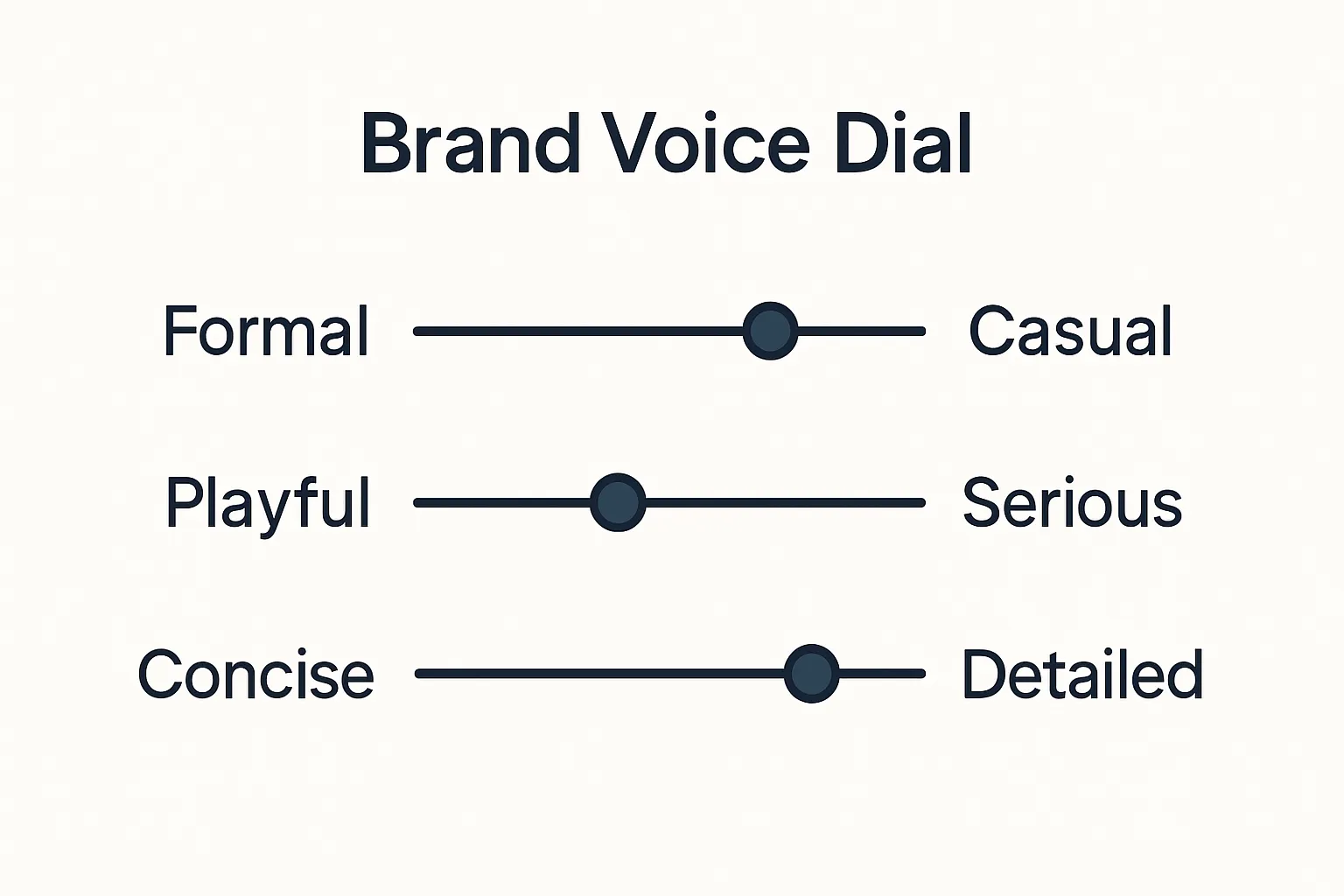 ### Build a brand voice card
- Tone sliders (1–5): Formal↔Casual, Playful↔Serious, Concise↔Detailed
- Banned phrases: [e.g., “game‑changer,” “cutting‑edge,” “unlock”]
- Reading level: [e.g., Grade 8–10]; sentence length cap: [e.g., ≤20 words]
- Jargon policy: Define allowed terms and plain‑English alternatives Prompt: Create a brand voice card for [Brand]. Include:
- Sliders (1–5): Formal/Casual, Playful/Serious, Concise/Detailed
- 6 “do” style rules + 6 “don’t” rules with examples
- Banned phrases list (10); preferred synonyms
- Reading level target; sentence/paragraph length guidance
- Jargon policy with allowed terms and plain-language swaps
Return a compact, scannable checklist I can paste atop briefs.
Voice‑match prompt
Feed 2–3 real paragraphs and extract the “voice DNA,” then apply it to your chatgpt for blog posts.
Prompt:
Analyze these 2–3 sample paragraphs (voice examples) and summarize the “voice DNA” in bullets:
- Syntax habits, cadence, vocabulary, rhetorical moves
- Persona cues (confidence, warmth, humor)
- Formatting preferences (bullets, short paragraphs, examples)
Then rewrite [this draft/section] to match that voice DNA. Preserve facts, claims, links, and structure.
Readability and scannability
Prompts to shorten, front-load value, and format for skim readers.
Prompt:
Improve readability and scannability:
- Shorten sentences (>20 words) and paragraphs (>4 lines)
- Convert walls of text into bullets with parallel structure
- Lead subheads with value (benefit/action first)
- Highlight key terms once per section; remove redundant setup
Return revised copy + a bullet list of edits made.
Consistency pass
Unify style choices so your writing blog content stays consistent across posts.
Prompt:
Run a consistency pass:
- Tense: [present/past]; Person: [1st/2nd/3rd]
- Capitalization & hyphenation rules (e.g., e‑commerce vs ecommerce)
- Nomenclature: standardize product names, features, acronyms
- Number style (e.g., 1–9 spelled out; 10+ numerals), date format
- Link style: internal vs external; anchor text conventions
Output: corrected copy + a style delta report showing changes.
Fact‑checking, citations, and originality safeguards
Great posts earn trust because they prioritize evidence, verification, and clear attribution - especially when using ChatGPT for blogs. Use these prompts to anchor claims in primary sources, prevent hallucinations, and keep writing blog content original and people‑first.
"E‑E‑A‑T helps determine if content is helpful, reliable, and created for people." - Source
Evidence‑first prompts
Force the model to propose sources before claims; cite inline
Prompt (use before drafting each section):
Before writing, propose 6–10 sources for H2 “[topic]”:
Label each as Primary (original data/research) or Secondary (summaries/opinion).
For each, add: Title, Author/Org, Year, URL, Why it’s credible, What claim it supports. Wait for my approval. Then draft the section with inline citations:
Use (Author/Org, Year) after each statistic or definition.
Link the first mention of each source.
Prefer primary sources over secondary; avoid tertiary/AI summaries. If no credible source exists, state “No authoritative source found” and ask to reframe.
### Verification workflow
- Cross‑check against primary sources; add rel=“nofollow” where appropriate Prompt (post‑draft verification):
Run a verification pass:
Extract every claim with a number, date, or quote into a checklist.
For each claim, verify against the primary source (not a blog or aggregator).
If only secondary sources exist, flag for SME review.
Replace any broken/redirected links; record access date (YYYY-MM-DD).
Mark affiliate/UGC/community links as rel="nofollow" (and rel="sponsored" for paid).
Confirm data freshness: if older than [X months], add “as of [Month Year]”. Return:
Corrected copy with updated citations.
A verification log: Claim → Source URL → Status (verified/updated/flagged).
### Anti‑hallucination guardrails
- Prompts to refuse unsourced facts and suggest safe wording Prompt (apply during drafting with ChatGPT for blog posts):
Anti-hallucination rules:
Do not invent facts, stats, names, or quotes.
If a requested fact lacks reputable sourcing, reply: “No reliable primary source found. Suggested safe wording: [neutral phrasing]”
Prefer phrasing such as “According to [Author/Org, Year]…” and “As of [Month Year]…”.
For definitions, cite standards bodies or original whitepapers.
For market sizes, cite the latest report edition; include methodology caveat. Proceed only when at least one trustworthy source is provided per claim.
### Originality & disclosure
- Prompts for re‑angle suggestions; add an AI‑assistance disclosure Prompt (to ensure originality and people‑first value):
Re-angle this outline to add originality:
Suggest 5 angles that incorporate our proprietary data, customer anecdotes, or SME quotes.
Map each angle to 2 unique examples (screenshots, steps, metrics).
Identify where we can add internal benchmarks or mini case studies.
Remove overused talking points; propose fresh framing for each H2. Return a revised outline with originality notes per section.
Prompt (transparent AI assistance disclosure):
Generate a brief disclosure to place near the footer: “This article was drafted with AI assistance and edited by [Brand]’s team for accuracy, clarity, and originality. Sources are cited inline.” Tone: neutral, professional, people-first. One sentence.
## On‑page SEO with prompts: titles, meta, schema, internal links Use these copy‑ready prompt templates to make ChatGPT for blog posts ship SEO‑aligned elements fast - without sounding robotic. This section covers titles/H2s, meta and slugs, internal links, and optional schema you can add in seconds. ### Titles and H2s that match intent (chatgpt blogs)
- Aim for benefit‑led, 60‑character titles with the primary keyword up front.
- Use H2s that map to search intent (informational vs transactional) and reflect PAA themes. Prompt starter:
- “Write 8 title options under 60 characters for [topic]. Put the primary keyword first. Match [intent]. Return with estimated pixel width.” ### Meta descriptions and slugs
- Metas: 150–160 characters, lead with value and unique differentiator.
- Slugs: short, lowercase, hyphen‑separated, include primary keyword, remove stop words. Prompt starter:
- “Generate a 155‑character meta that starts with [primary keyword] and includes a benefit + soft CTA. Propose 3 clean slugs (<=60 chars).” ### Internal linking & anchor text
- Surface 5–8 relevant internal links and natural anchors that reflect the target page’s H1.
- Avoid exact‑match stuffing; vary anchors semantically. Prompt starter:
- “From this outline, list 5–8 internal link opportunities. Return: Anchor text (natural), Target URL (placeholder is fine), Insert under H2.” ### Optional extras
- Ask ChatGPT to draft FAQPage schema from your PAA cluster; add HowTo schema if your article includes steps. Prompt starter:
- “From these PAA Q&As, create valid FAQPage JSON‑LD (no HTML). If step‑by‑step exists, also draft HowTo JSON‑LD.” ### On‑Page SEO Prompt Cookbook | Element | Goal | Prompt template | Acceptance criteria | Example output snippet |
| --- | --- | --- | --- | --- |
| Title | Max CTR with exact‑match up front | “Write 10 titles ≤60 chars for [topic]. Put ‘[primary keyword]’ first. Match [intent]. Include 1 curiosity angle, 1 benefit angle, 1 authority angle. Return char count + pixel width.” | ≤60 chars; primary keyword first; intent‑aligned; unique; no clickbait | “ChatGPT Blog Prompts: Faster SEO Drafts (47c)” |
| H2s | Structure that maps to intent & PAA | “Create H2/H3s for [topic]. Map each H2 to intent (info/transactional) and attach 1–2 PAA questions as H3s. Include [secondary keywords] naturally.” | Complete coverage; logical order; PAA attached; no duplication | H2: “Outline With OPAL” H3: “What is search intent?” |
| Meta | Entice the click in 150–160 chars | “Write 3 metas (150–160 chars) for [topic]. Start with [primary keyword], include 1 benefit + 1 action. Avoid title duplication.” | 150–160 chars; contains benefit + soft CTA; unique; non‑truncated | “ChatGPT blog prompts that match intent and ship faster. See templates, examples, and a runbook to publish confidently.” |
| Slug | Clean, keyword‑rich URL | “Propose 3 slugs ≤60 chars, lowercase, hyphenated, no stop words. Include [primary keyword] at start.” | ≤60 chars; lowercase; hyphenated; primary keyword included; no dates | chatgpt-blog-prompts |
| Internal Links | Pass authority and help navigation | “Suggest 5–8 internal links from our library [list or sitemap]. For each: Natural anchor (<=6 words), target URL, best insertion H2.” | 5–8 links; high topical relevance; varied anchors; no exact‑match stuffing | • “prompt frameworks” → /blog/prompt-frameworks (H2: OPAL) |
| FAQ schema | Capture FAQ rich results | “Create FAQPage JSON‑LD for these Q&As: [list]. Validate fields; no HTML. Keep answers ≤120 words.” | Valid JSON‑LD; ≤5 Q&As; concise, factual answers; no marketing copy | {“@context”:“https://schema.org”,“@type”:“FAQPage”,“mainEntity”:[{“@type”:“Question”,“name”:“What are ChatGPT blog prompts?”,“acceptedAnswer”:{“@type”:“Answer”,“text”:“They are structured instructions that guide ChatGPT to produce on‑brand, SEO‑aligned content components like outlines, drafts, and edits.”}}]} | Tips:
- After generating titles/metas, ask for variants that emphasize different benefits (speed, accuracy, E‑E‑A‑T).
- For internal links, provide your top categories or a sitemap to improve relevance.
- Validate schema in a structured data testing tool before publishing. ## Scale your workflow with BlogBowl (automation that compounds) Pair ChatGPT’s speed with BlogBowl’s automation to turn your content operation into a compounding engine. BlogBowl handles the heavy lifting - research, drafting, media, linking, publishing, and promotion - so your team focuses on strategy and subject‑matter insight. 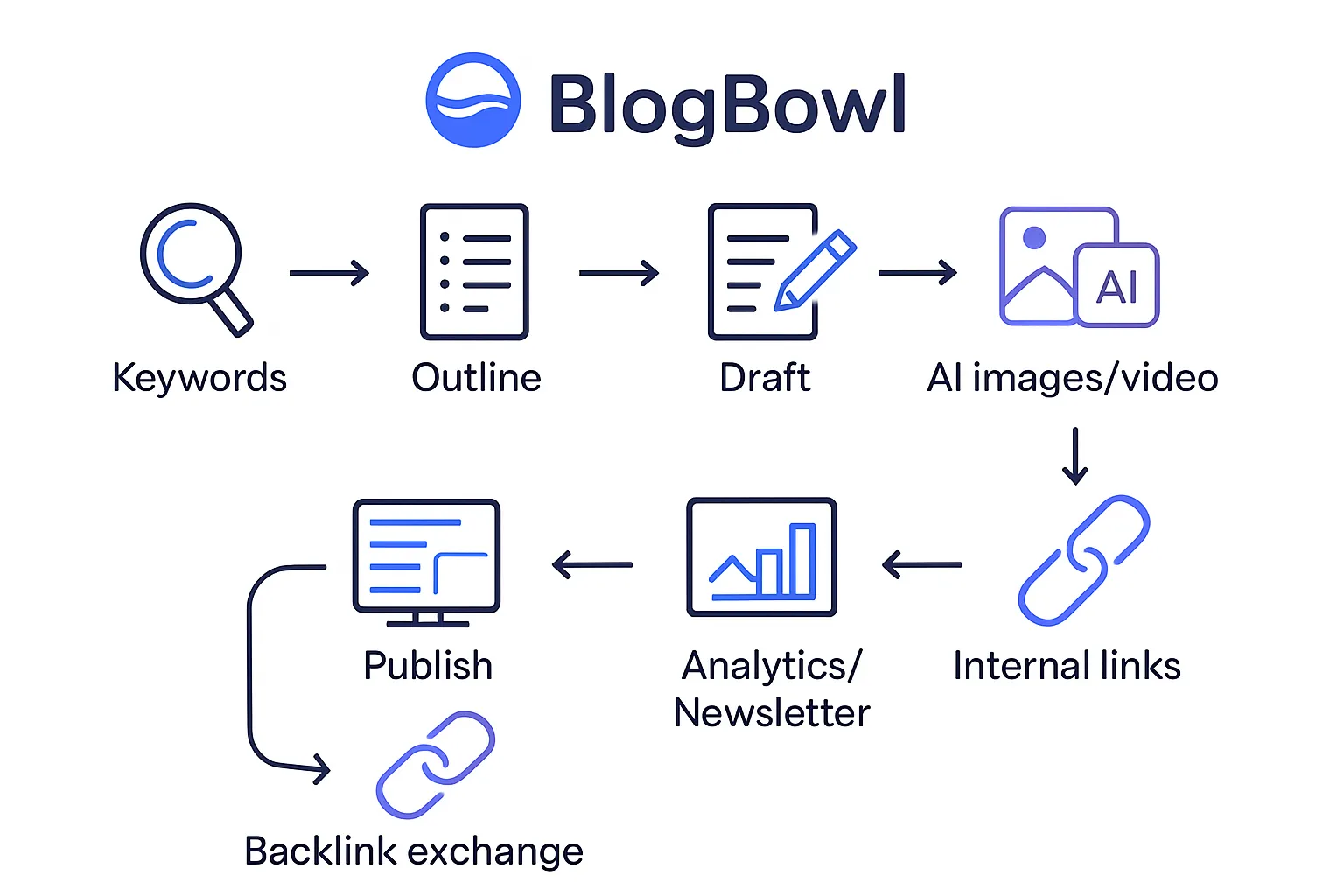 ### Why BlogBowl + ChatGPT beats DIY
- Daily SEO‑optimized drafts, internal linking, keyword research, AI images, embedded videos
- Fast, SEO‑ready templates designed for Google and LLM visibility
- Automatic internal link building and content freshness updates ### Multi‑blog orchestration
- Manage unlimited blogs, authors, and custom domains without code
- Centralize content briefs, workflows, and approvals across teams
- Consistent brand voice via reusable prompt packs and voice cards ### Built‑in analytics and newsletter
- Publish, track, and promote from one place with privacy‑friendly analytics
- Integrated newsletter to repurpose posts into sends with a click
- UTM automation and impression/click tracking across posts ### Backlink exchange and LLM visibility
- Automatic backlink exchange to accelerate authority growth
- Structured data, clean slugs, and lightning‑fast pages for SERP and AI search
- Designed for visibility in ChatGPT, Claude, and other AI assistants ## Conclusion: Ship better posts faster - start with BlogBowl You’ve now got the playbook to turn ChatGPT for blogs into a reliable engine: OPAL for outlines, OCEAN for drafts, TRACE for edits - plus prompts for on‑page SEO, citations, and originality. With BlogBowl automations handling publishing, internal links, analytics, and newsletters, you’ll spend less time writing blog content and more time scaling growth. ### Quick start
- Pick a keyword cluster → run the outline prompts → generate section drafts
- Apply TRACE edits → add citations → optimize on‑page SEO prompts ### Why start now
- Faster first drafts, stronger edits, consistent SEO wins
- Cleaner workflows that protect voice, accuracy, and E‑E‑A‑T
- A repeatable system you can scale across teams and multiple blogs ### Call to action
- Create your BlogBowl account to launch an SEO‑optimized blog in under 60 seconds and grow traffic on autopilot: https://www.blogbowl.io Ready to write the blog your audience actually wants - and publish it faster? Spin up your first post with these prompt recipes, then let BlogBowl keep the momentum going.