


Intro: What “topical authority” really means for blog rankings in 2025
Why topical authority beats one-off posts
Topical authority is your blog’s demonstrated depth on a subject - proving to Google and readers that you cover a theme comprehensively, not sporadically. Instead of publishing isolated posts, you build an interconnected body of content that answers every important question in your niche. The result: stronger blog authority, higher blog rankings, and a better user journey that turns visitors into subscribers and customers.
Unlike domain authority - which largely relies on other sites linking to you - topical authority is under your control. You earn it by planning smart clusters, publishing consistently, and using internal links help to connect the dots. With a clean seo blog structure (hubs, clusters, and contextual internal links), search engines can easily map your expertise and reward it.
"91.8% of Google search terms are long‑tail queries." - Source
That’s why topical depth matters so much. Long‑tail demand compounds when your content hub captures dozens (or hundreds) of related searches - and your internal links guide readers to exactly what they need. BlogBowl makes this easy with automated internal linking and cluster-aware publishing, so you can focus on the ideas while we handle the blog optimization.
What you’ll learn in this guide
A simple hub–cluster–internal link framework that builds blog authority fast - without a giant team.
Practical, low-lift playbooks plus automation options in BlogBowl to accelerate content velocity and internal linking.
How to measure gains (visibility, engagement, conversions) and optimize your seo blog structure over time with integrated analytics.
Who this is for
SaaS founders, marketers, content managers, and SMB teams aiming for blog optimization and sustained growth.
Why topical authority matters now: EEAT, AI search, and smarter clustering
From keywords to concepts
Search is moving from simple keyword matching to understanding concepts and intent. Semantic search and AI-generated summaries reward content that covers a topic thoroughly and connects related ideas. When your posts are organized into clear clusters - supported by a pillar page and rich internal links - search engines can map your expertise, and readers can navigate effortlessly. That clarity compounds blog rankings: clusters align pages to topics, while internal links distribute authority so newer posts don’t linger unseen.
Clusters also future‑proof your SEO. As AI summaries prioritize complete, trustworthy answers, a well‑structured seo blog structure signals comprehensive coverage. This improves blog authority and engagement in one motion - users find answers faster, and algorithms see coherent topical depth rather than scattered posts.
EEAT signals that reinforce blog authority
EEAT isn’t a checkbox - it’s the byproduct of consistent, high‑quality publishing around a topic.
Experience and expertise: Demonstrate depth with first‑hand insights, original examples, process screenshots, and clear how‑tos. Cite reliable sources to anchor claims and build credibility.
Authoritativeness: Publish pillar pages that connect related subtopics, and keep them fresh with updates. Share case studies or product walkthroughs to show real outcomes.
Trustworthiness: Prioritize accuracy, consistent terminology, and transparent sourcing. Internal links help users navigate from general to specific content, reinforcing trust and guiding discovery across your blog.
"You may usually think about linking in terms of pointing to external websites, but paying more attention to the anchor text used for internal links can help both people and Google make sense of your site more easily and find other pages on your site." - Source
Models compared
Traditional “post‑as‑you‑go” publishing can earn sporadic traffic, but it rarely builds durable topical authority. Hub‑and‑spoke clusters concentrate relevance, share equity, and scale internal linking with intent‑matched anchors - ideal for fast gains in blog rankings. The topic library model reorganizes content by subject rather than chronology, making discovery and maintenance simpler as your catalog grows. Many teams combine clusters (for growth) with a library (for discovery).
Below is a quick executive comparison to guide strategy selection.
Model | Content structure | Pros | Cons | Best for |
|---|---|---|---|---|
Traditional posts | Chronological feed of standalone articles | Fast to publish; flexible topics | Shallow coverage; orphan pages; diluted relevance | Early-stage blogs testing topics or news-style updates |
Hub & cluster | Pillar page with interlinked spokes on subtopics | Concentrates relevance; boosts crawlability; internal links distribute authority; clearer user paths | Requires planning and ongoing maintenance | SaaS and SMB teams aiming for rapid blog optimization and stable growth |
Topic library | Evergreen, topic-based navigation (collections) | Superior UX; easy discovery; supports long-term maintenance | Setup effort; still needs clusters inside to rank competitively | Mature blogs with growing catalogs and multiple audiences |
In practice, the fastest route to blog authority is a hybrid: build clusters to win topics, then present them within a library-like structure so users and crawlers can find everything quickly. With consistent internal linking and clear anchors, links help both discovery and conversions - making your content easier to trust, easier to navigate, and easier to rank.
The blueprint: Hubs, clusters, and internal links that lift blog rankings
Define the pieces
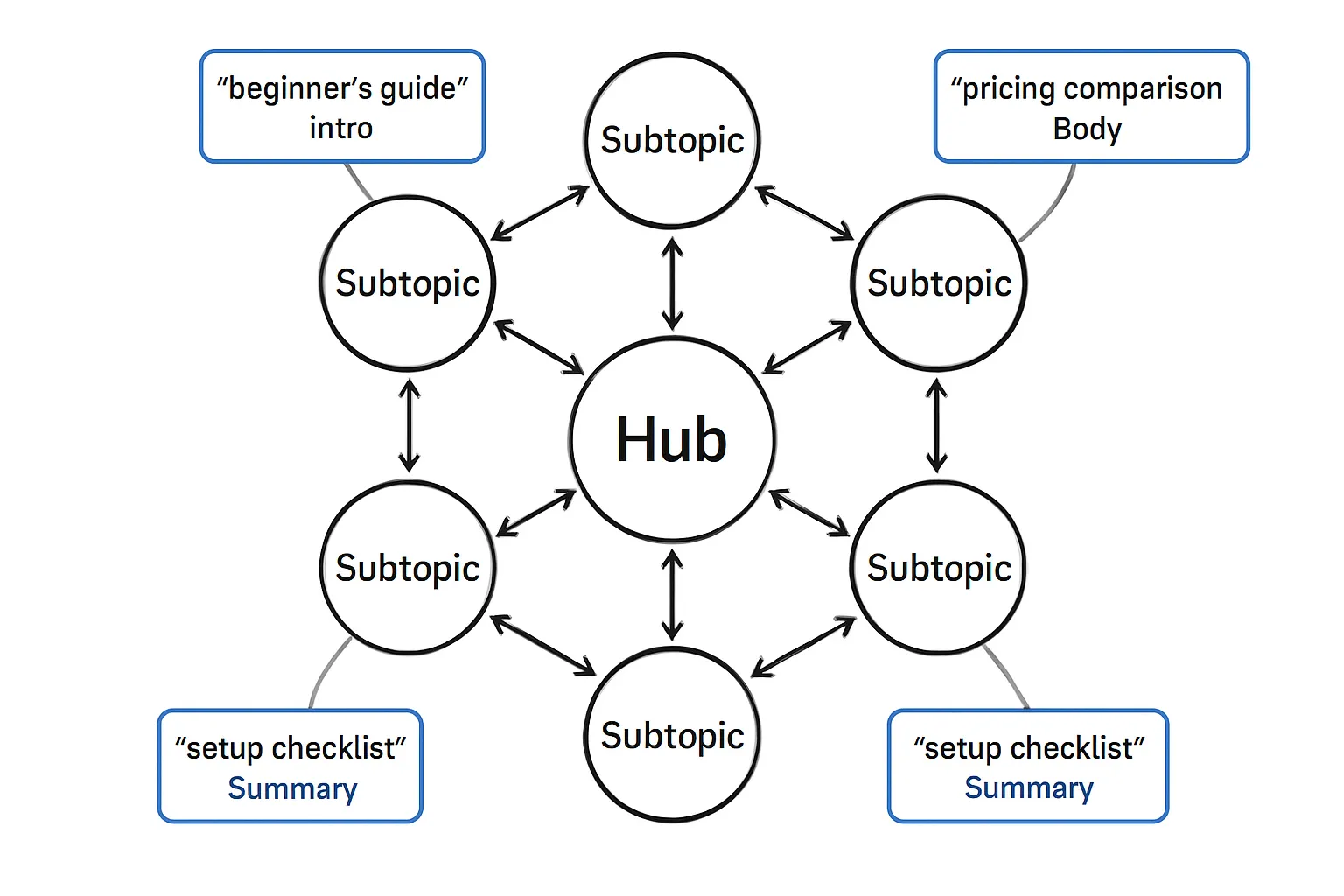
Pillar (hub): Your comprehensive guide on a core topic that anchors the cluster. It introduces the theme, summarizes key subtopics, and links to each spoke with clear, intent-matched anchors.
Cluster (spokes): Focused articles answering specific subtopics and intents. Each spoke dives deep into one angle, links back to the hub, and cross-links to related spokes to prevent orphan content.
Internal links: Context-rich connections that signal relationships, distribute authority, and guide readers. Use descriptive anchors, place links where they’re most helpful, and ensure bidirectional links hub ↔ spokes.
How to structure a pillar and spokes for topical coverage
Internal link placement that impacts crawlability and relevance
Anchor text patterns that reinforce search intent
Common pitfalls: thin hubs, weak cross-links, vague anchors
How authority flows
Link equity distribution from hub ↔ spokes: When your hub earns links (or ranks), internal links pass equity to spokes; strong spoke pages feed authority back to the hub, stabilizing rankings across the cluster.
Contextual anchor text matters: Use anchors that match intent and subtopic (e.g., “setup checklist,” “pricing comparison,” “advanced tips”). Avoid generic “click here.”
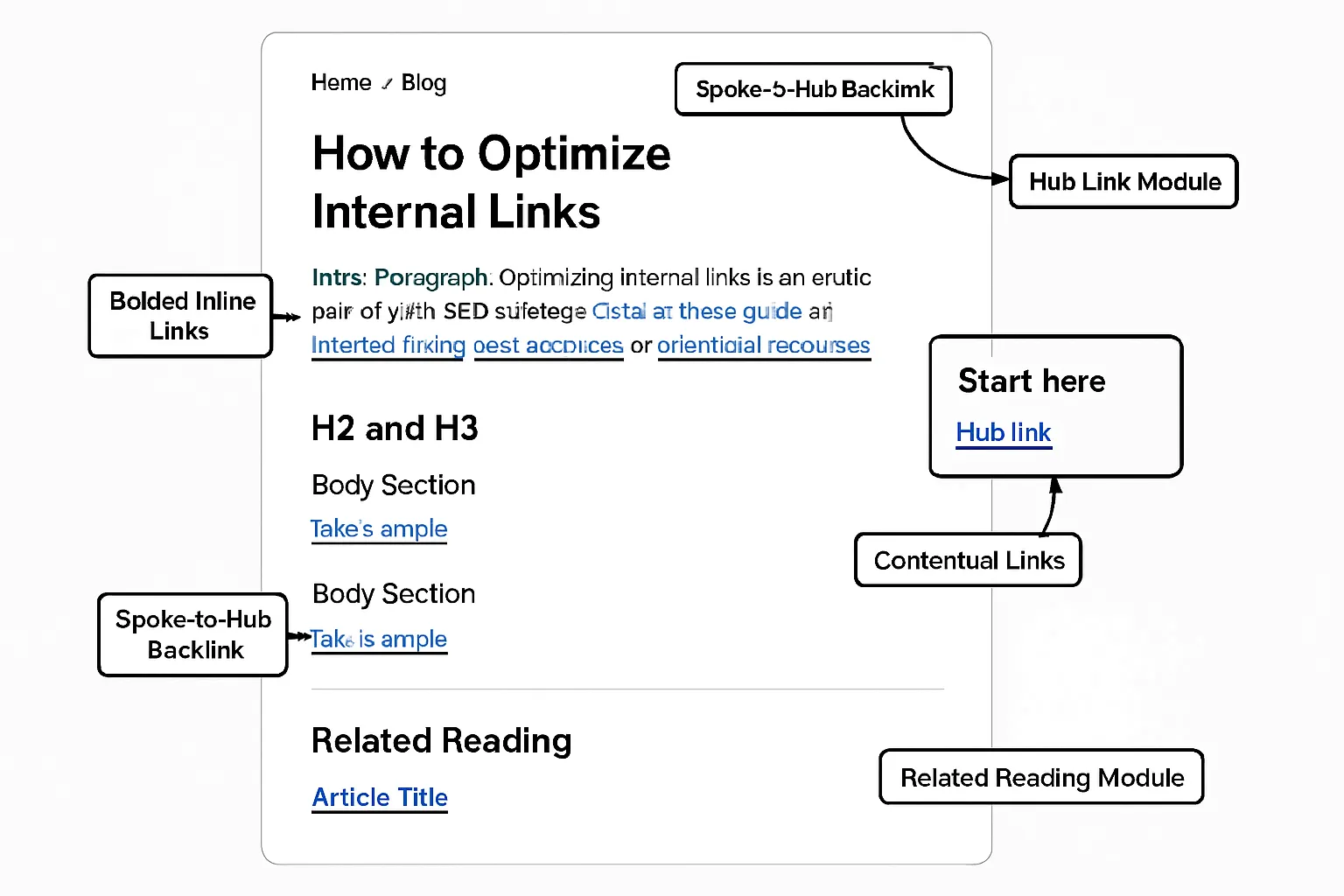
Placement and proximity: Add critical links early (intro or first third) for faster crawling, then reinforce in body sections and summaries. Link near relevant headings and key phrases.
Cross-link related spokes: Connect overlapping subtopics (e.g., “setup” → “troubleshooting” → “best practices”) to strengthen thematic signals and user paths.
Quick wins vs. durable gains
In weeks: Expect faster crawling, rising impressions for long‑tail terms, and improved sitelinks/coverage as internal links clarify structure.
In months: See rank stability on hub terms, broader keyword coverage across the cluster, higher session depth, and compounding traffic as more queries map to your content.
Operational tip: With BlogBowl, hubs, clusters, and internal links are automated - so new posts are instantly connected to relevant pages, anchors stay descriptive, and your cluster grows without manual work.
Map your topical universe: Build clusters that prove expertise
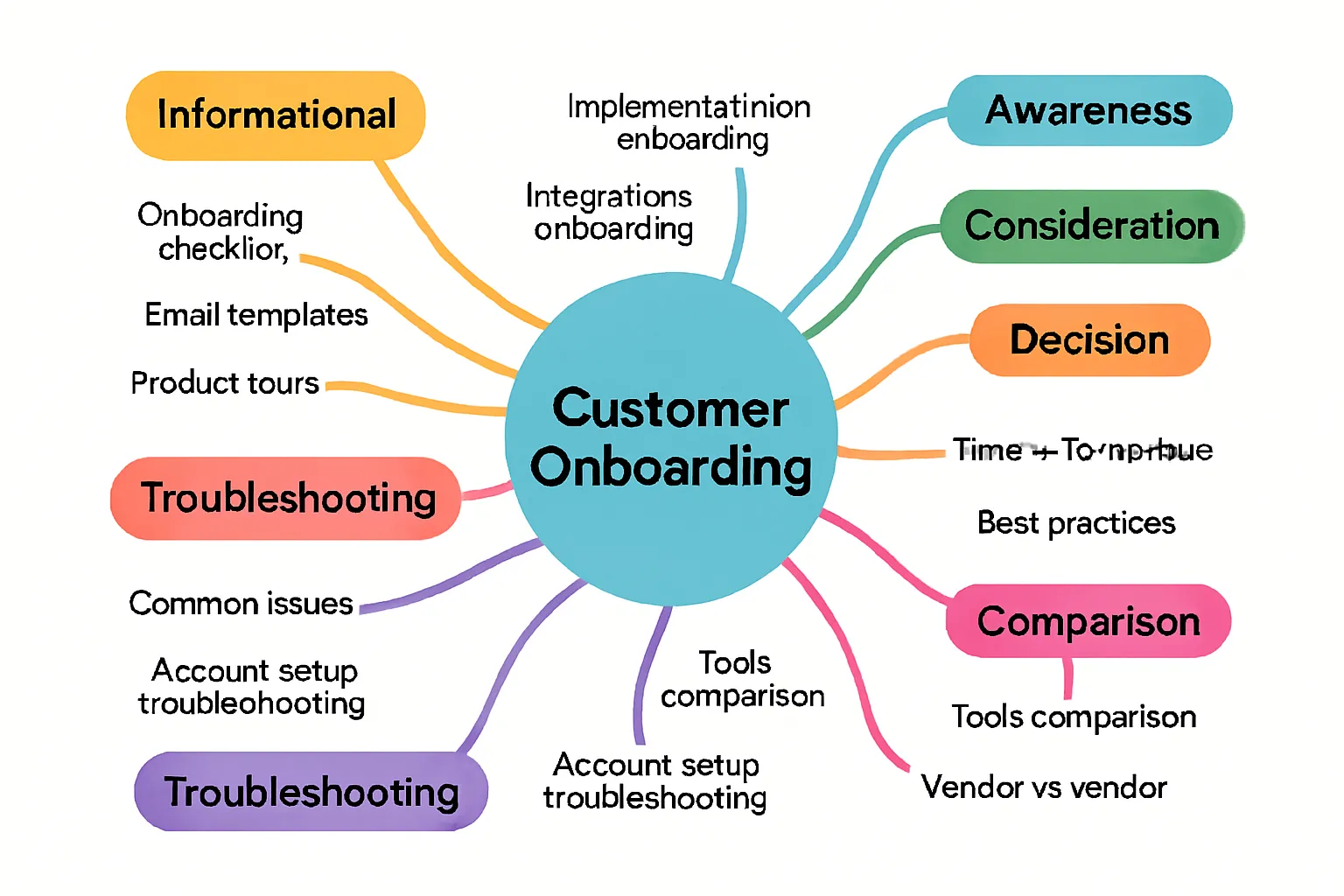
Step 1: Pick 3–5 authority themes
Tie themes to your product, feature, or problem spaces. Examples for SaaS: customer onboarding, AI assistance, analytics governance, pricing and packaging, or migration and integrations.
Validate with demand signals. Scan the SERP (top‑ranking patterns, content gaps), People Also Ask questions, Search Console queries, and sales/support FAQs to confirm real user demand and phrase topics in user language.
Step 2: Expand to a topical surface area
Generate subtopics by intent:
Informational: definitions, principles, benefits, metrics (e.g., time‑to‑value, onboarding KPIs).
How‑to: setup checklists, implementation guides, templates, workflows, integrations.
Comparison: product categories, vendor vs vendor, features vs outcomes, build vs buy.
Troubleshooting: common issues, errors, rollbacks, security/permissions nuances.
Group keywords by parent topics and avoid cannibalization. Use parent topics to decide when to combine vs separate pages. Map one primary intent per URL; consolidate overlapping terms into the strongest page and redirect weaker variants when needed.
Step 3: Prioritize with business impact
Align to revenue drivers and user journeys. Sequence clusters to support key motions (self‑serve trial, sales‑assisted demo, onboarding, expansion). Attach each subtopic to a funnel stage and conversion action.
Stage work in 2–3 sprints per theme for faster indexation. Sprint 1: publish the pillar plus 3–5 spokes; Sprint 2: add missing intents and internal links; Sprint 3: refresh with FAQs, examples, and cross‑links from legacy posts.
Create the content: Pillars, clusters, and anchor text that search loves
Pillar (hub) content essentials
Scope broadly, link deeply: Outline the entire topic and include concise sections that tee up each spoke. Summarize the subtopic, answer the “why it matters,” and link to the full guide.
Information gain: Add original data, frameworks, and practitioner walkthroughs. Include screenshots, templates, and decision trees that aren’t found elsewhere.
UX patterns that boost blog rankings: Clear TL;DR, scannable H2/H3s, inline definitions, and a “Related Resources” section that consolidates your most important internal links help users move from general to specific.
Maintenance for blog optimization: Refresh quarterly with new FAQs, updated metrics, and links to any newly published spokes to keep the seo blog structure coherent.
Cluster (spoke) content essentials
One intent per page: Answer fast in the intro; deepen with steps, rationale, and edge cases.
Helpful depth: Include checklists, examples, templates, and FAQs that attract links and shares.
Consistent structure: Problem → quick answer → step-by-step → examples → pitfalls → related links. Map each spoke back to the hub and cross-link to adjacent spokes to reinforce blog authority.
Conversion assists: Add contextual CTAs (“See it in BlogBowl,” “Download checklist”) without interrupting flow.
Anchor text and on-page patterns
Descriptive, intent-aligned anchors: Use natural, specific phrases like “onboarding checklist for SaaS” instead of generic “click here.”
Placement: Put the most important internal links in the intro and the first third of the page; reinforce with contextual links near headings and summaries.
Variants without over-optimization: Rotate partial‑match anchors (e.g., “compare onboarding tools,” “onboarding tools comparison”) and include entity-rich phrases.
Density and relevance: 2–6 internal links per 1,000 words, placed where users expect next steps.
Anchor text playbook
Intent | Example anchor | Links to | Notes |
|---|---|---|---|
Informational | onboarding best practices for SaaS | Pillar (hub) page | Use for broad “learn” queries; place early in the intro. |
Transactional | start a free trial of BlogBowl | Product/demo/pricing page | Reserve for bottom-of-funnel paragraphs; keep anchors natural. |
Comparison | onboarding tools comparison | Comparison spoke | Align to versus/list posts; include adjacent links (e.g., “build vs. buy”). |
Troubleshooting | fix common onboarding email issues | Troubleshooting spoke | Pair with a short fix summary; link back to hub for context. |
Editorial operations
Briefs that win: Define audience, intent, primary/secondary keywords, internal link targets (hub + nearest spokes), and CTAs.
Outlines with information gain: Require original examples, data points, or process screenshots per major heading.
Review checklists: Accuracy, intent match, completeness of internal links, anchor text quality, alt text, and schema/metadata alignment.
Fact-checking and SME review: Attribute claims, cite reputable sources, and have a practitioner validate steps and edge cases.
Publish and connect: On publish, add links from relevant legacy posts to the new page, and from the hub to spoke (and vice versa) to strengthen the cluster.
Operational note: BlogBowl auto-generates briefs, surfaces internal link opportunities, and keeps anchors descriptive - so your clusters stay connected and your blog authority compounds with less manual effort.
Internal linking playbooks: Fast wins for better crawl, UX, and rankings
Playbook A: Hub-first navigation
Add a “Start here” hub module at the top of your pillar with in‑line links from the hub to each spoke. Include short, intent‑aligned anchors and a one‑line summary for each link.
Link from every spoke back to the hub in the first 2–3 paragraphs using descriptive anchor text that matches the hub topic. This stabilizes rankings and clarifies the hierarchy for crawlers and users.
Playbook B: Contextual retro-linking
Audit existing posts to identify pages with impressions but low clicks and add 3–5 contextual links pointing to your new hub and relevant spokes. Place the first link in the intro or first third of the article.
Refresh anchor text to match current search intent. Replace vague anchors with specific phrases like “onboarding checklist,” “pricing comparison,” or “setup steps” to improve relevance.
Playbook C: Related reading and breadcrumbs
Use auto‑generated related links components that are cluster‑aware (same topic, complementary intent). Position near the conclusion and at logical pivots in the body.
Add breadcrumbs to expose hierarchy, reinforce topic clusters, and improve sitelinks. Keep labels concise and keyword‑clear.
"Paying more attention to the anchor text used for internal links can help both people and Google make sense of your site more easily and find other pages on your site." - Source
Placement rules and frequency
Aim for 2–6 internal links per 1,000 words. Prioritize helpfulness over volume, placing links where readers naturally need the next step.
Put critical links early (intro/first third) for faster discovery, then reinforce in body sections and summaries. Cross‑link related spokes to prevent orphan content and strengthen topical signals.
Scale without strain: Automate clusters and internal links with BlogBowl
Why automation matters for SMB and SaaS teams
Publishing stalls when research, outlining, approvals, and linking pile up. Automation removes friction so you keep momentum without adding headcount.
Topic cadence drives blog rankings. Consistent output in a clean SEO blog structure builds blog authority faster than sporadic posting.
Internal links help readers and crawlers. Automating link discovery and placement ensures every post contributes to your clusters from day one.
What BlogBowl automates for you
AI-powered topic discovery, keyword research, and cluster planning: We surface authority themes, map hubs and spokes, and generate outlines aligned to search intent.
Daily SEO-optimized articles with automatic internal linking and embedded media: BlogBowl drafts, edits, and publishes posts; descriptive anchors connect hub ↔ spokes, and we embed relevant images and videos automatically.
Fast, SEO blog structure templates and no-code customization: Launch a professional blog in under 60 seconds with fast-loading, search-friendly layouts you can tailor to your brand.
Automatic backlink exchange and interlink insights: Pair with complementary sites and get smart suggestions to strengthen topical coverage.
Workflows that compound
Launch multiple hubs in parallel; spokes scheduled across weeks: Spin up 2–4 clusters at once, then drip spokes to speed indexation and spread link equity.
Auto retro-linking: New posts trigger updates on relevant legacy posts so authority flows across your site immediately.
Built-in newsletter + analytics: Turn clusters into drip newsletters, capture subscribers, and track open/click trends alongside search performance.
Measure authority growth: Monitor impressions, ranked queries per cluster, internal link coverage, and session depth to refine blog optimization.
Integrations and governance
Custom domains and flexible embedding: Connect your domain or integrate with your existing site and no-code tools in minutes.
Multi-blog management: Run unlimited blogs, changelogs, and help docs from one dashboard.
Multi-author roles and approvals: Invite contributors with permissions, apply review checklists, and keep quality high without bottlenecks.
Privacy-friendly analytics: Built-in metrics for traffic, engagement, and cluster coverage - no cookies required.
With BlogBowl, hubs, clusters, and internal links are on autopilot - so your team can focus on expertise while we handle the planning, production, and structure that search (and readers) love.
Measure authority growth: Simple metrics, dashboards, and decisions
What to track weekly vs. monthly
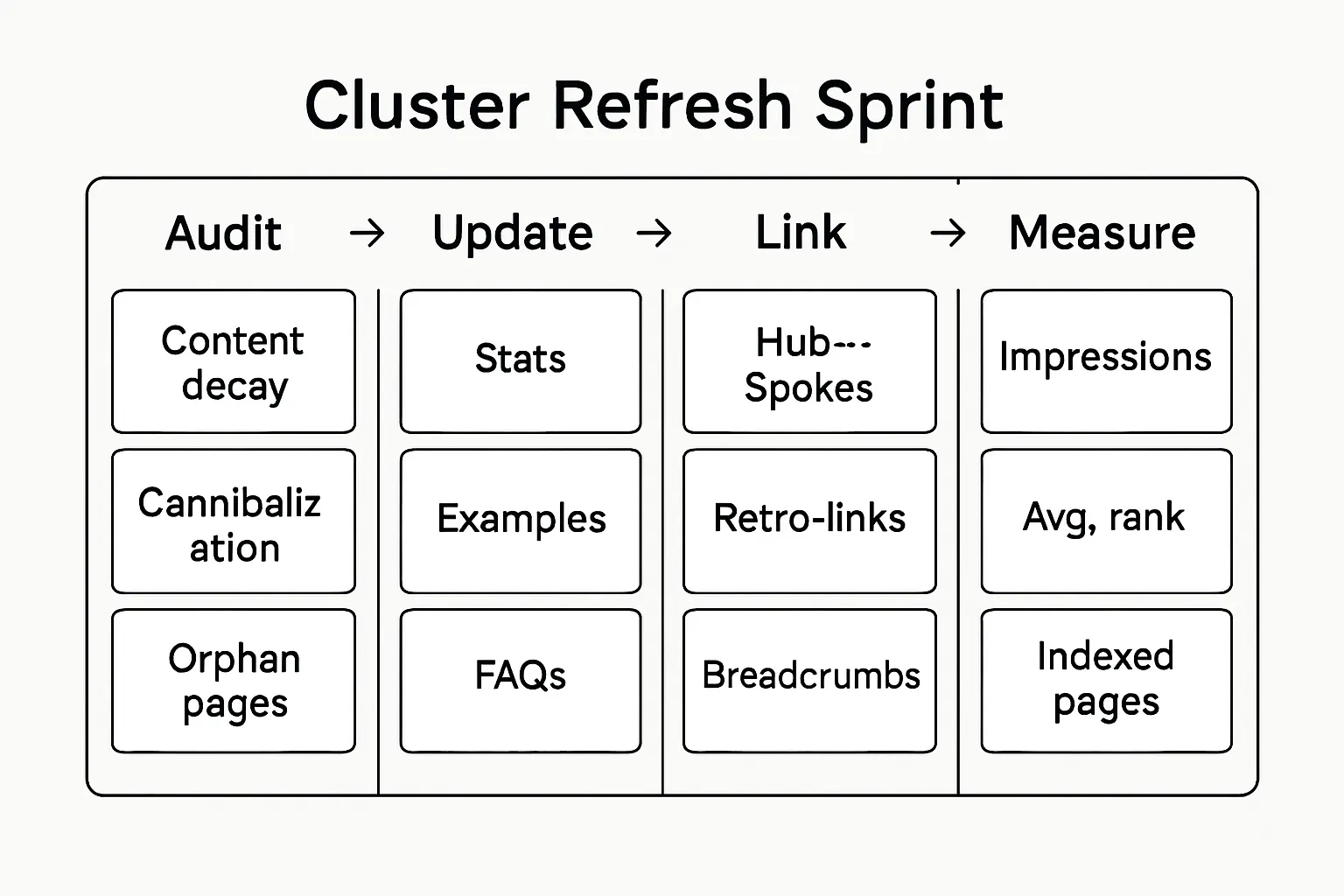
Weekly: impressions (GSC), queries per hub (coverage growth), indexation status (new URLs discovered/valid), and internal link coverage (hub ↔ spokes and spoke ↔ spoke connections).
Monthly: hub keyword footprints (unique ranking queries per hub), average position by cluster (focus on top‑20 movement), and assisted conversions (newsletter signups, demos, trials attributed to content paths).
"96.55% of all web pages get no organic traffic from Google." - Source
That’s why a structured clustering approach - plus consistent internal linking - matters. It increases discoverability, spreads equity, and turns isolated posts into a connected system that earns and keeps rankings.
Tools and reports
GSC, analytics, rank trackers, and BlogBowl’s built‑in reports: Combine GSC query/impression data, analytics conversions, and rank tracking with BlogBowl’s cluster views (hubs, spokes, internal link counts) for a single source of truth.
Spot winners to funnel more internal links: Identify rising pages (impressions up, rank improving, CTR lagging) and link to them from relevant hubs/spokes. Add links in the first third of strong legacy posts to accelerate gains.
Authority growth dashboard
KPI | Definition | Source | Benchmark/Target | Action if below target |
|---|---|---|---|---|
Impressions per hub | Weekly impressions across all pages in a hub | GSC | +10–20% MoM during active sprints | Add 2–3 new spokes; strengthen hub intro links; fetch/index new pages |
Avg. rank (top 20) by cluster | Average position for top 20 keywords in the cluster | Rank tracker/GSC | Reach avg. pos. < 20 in 6–8 weeks | Improve titles/meta, add FAQs, add 3–5 contextual links from legacy posts |
Internal link count to hub | Total internal links pointing to the hub (unique pages) | BlogBowl/Internal crawl | Hub is top‑linked page in cluster | Add hub links in first 2–3 paragraphs of all spokes; add “Related” blocks |
Indexed pages per cluster | Valid URLs indexed vs. published in cluster | GSC Index Coverage | >90% indexed within 14–21 days | Fix crawl blocks; add sitemap/pings; interlink from high‑crawl pages |
Assisted conversions | Conversions with content touchpoints in path | Analytics/BlogBowl | +10–15% QoQ | Add BOFU CTAs in hubs/spokes; create comparison/trust pages; tighten links |
Make decisions, not just reports
Add new spokes when a hub’s impressions rise but rank plateaus - cover missing intents (how‑to, comparison, troubleshooting).
Consolidate pages when two URLs compete for the same terms; merge content, 301 the weaker URL, and update internal links.
Refresh content if impressions drop or queries shift - update examples, add FAQs, and improve anchor text to align with current search intent.
Maintain momentum: Refresh sprints, consolidation, and link hygiene
Quarterly refresh sprints
Update stats, examples, and FAQs to reflect the latest reality. Add new internal links to rising posts and connect fresh content back into hubs and related spokes.
Expand top-performing spokes into mini-hubs when justified. If a spoke begins ranking for multiple intents, promote it to a hub with its own spokes and redirect relevant subpages.
Consolidation and cannibalization fixes
Merge overlapping posts and redirect to the strongest URL. Combine the best sections, preserve headings that rank, and implement 301s; then update all internal links to the canonical page.
Normalize anchors to avoid mixed signals. Standardize descriptive anchors to the canonical URL (e.g., “onboarding checklist” → hub), and prune duplicate anchors that point to different destinations.
Link hygiene
Fix orphan pages by linking them from hubs and contextually related posts. Add breadcrumbs for hierarchy clarity.
Prune dead-end links. Replace outdated links with relevant, cluster-aware targets.
Ensure every new post links to a hub + at least 2 spokes in the first third of the article.
Team templates
Checklists for briefs, editing, and QA: audience and intent, primary/secondary keywords, internal link targets, anchor text quality, facts and citations, CTAs.
Publishing runbooks for repeatability: pre‑publish checks (links, metadata, schema), go‑live tasks (sitemap ping, social/email), and post‑publish retro‑linking to legacy posts.
Conclusion: Start building blog authority on autopilot with BlogBowl
Your next best step
Pick one core theme your audience cares about.
Launch a hub that summarizes the topic and links to focused spokes.
Publish 3–5 spokes covering distinct intents (how‑to, comparison, troubleshooting, FAQs).
Connect everything with descriptive, intent‑aligned anchors so internal links help both readers and crawlers.
This single sprint upgrades your seo blog structure, accelerates crawl and indexation, and starts compounding blog authority and blog rankings.
Why BlogBowl for faster wins
Launch a professional, SEO‑optimized blog in under 60 seconds - no code required.
Automate the heavy lifting: topic discovery, cluster planning, daily articles, embedded media, and automatic internal linking that keeps clusters tight.
Built‑in, privacy‑friendly analytics plus rank‑aware insights to guide your next spokes, consolidate overlaps, and improve blog optimization over time.
Call to action
Create your BlogBowl account and turn hubs, clusters, and internal links into a repeatable growth engine. Scale content, strengthen blog authority, and convert more readers - while BlogBowl handles the planning, publishing, and structure that search (and your customers) love.