


Blog SEO Optimization: A Practical Guide to Ranking Blog Posts
If you run a SaaS company blog, publishing more posts is not the same as doing blog SEO well.
A lot of teams ship content fast, then wonder why traffic stays flat. Usually the problem is not effort. It is structure. The post targets the wrong intent, the title is weak, the internal links are thin, or the technical basics are shaky. That is where blog SEO optimization becomes the difference between “content published” and “content that compounds.”
This guide is built for founders, marketers, startup teams, indie hackers, and B2B product teams who want a practical, no-fluff seo optimization guide they can actually use. We will cover how blog seo differs from general website SEO, how to create seo optimized posts, what to fix after publishing, and how to measure results without drowning in dashboards.
At BlogBowl, we think blog SEO should feel simple: launch fast, publish without engineering help, track what matters, and grow from one platform. That is exactly why BlogBowl combines a no-code editor, fast SEO-ready templates, built-in newsletter tools, analytics, custom domains, and multi-surface publishing for blogs, changelogs, and help docs.
"45% of marketers consider websites, blogs, and SEO as their primary marketing channels." - HubSpot's 2026 State of Marketing Report
What blog SEO actually means
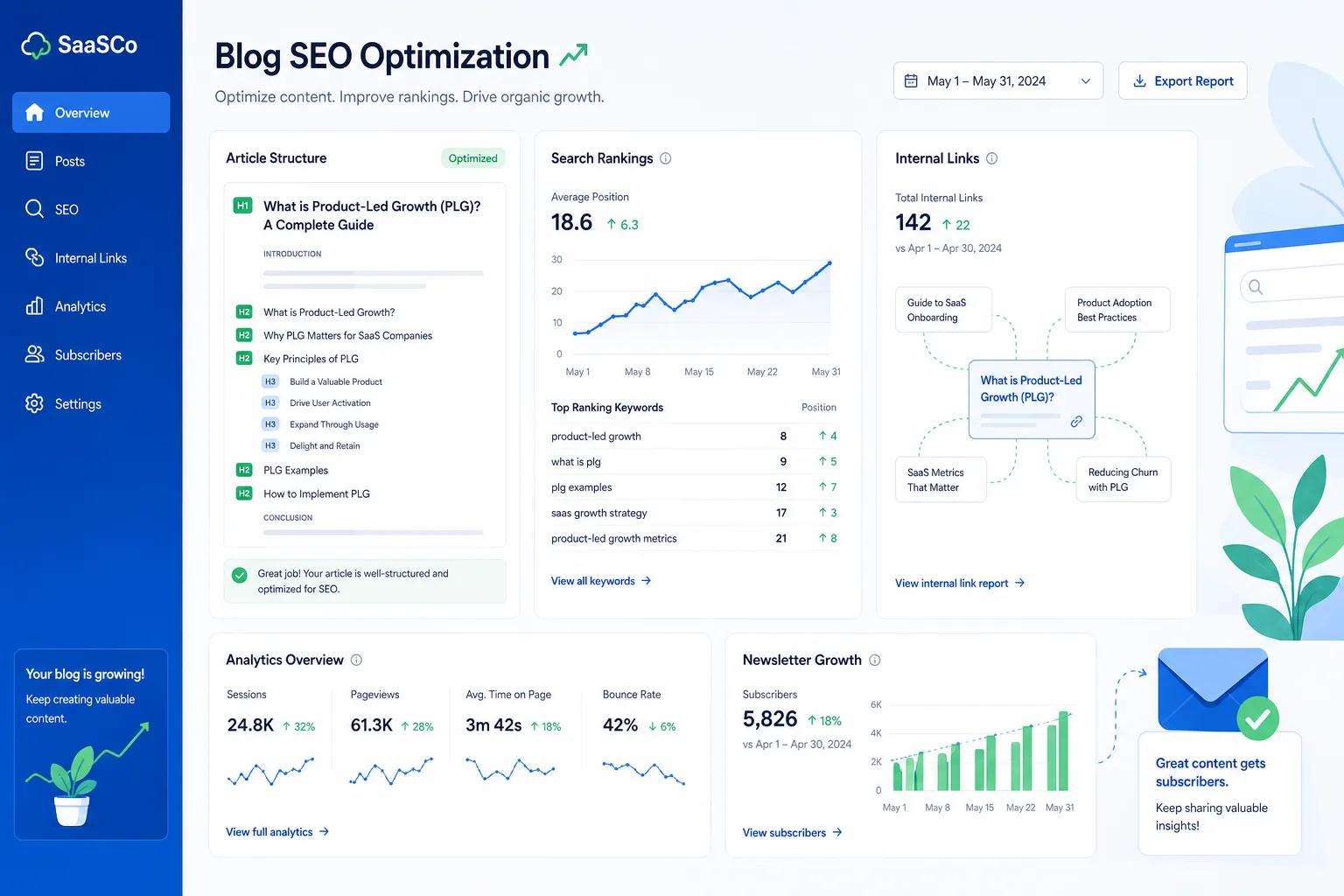
Blog SEO is the process of optimizing blog posts so they can rank for relevant searches, attract qualified traffic, and move readers toward a goal.
That goal might be:
Trial signups
Demo requests
Newsletter subscriptions
Product awareness
Self-serve education
Support deflection through help content
A good seo optimized blog post does not just mention a keyword. It aligns with search intent, answers the query clearly, loads fast, is easy to scan, links to related pages, and gives search engines enough context to understand the page.
Blog SEO vs general website SEO
This is where many teams get mixed up.
Area | Blog SEO | Website SEO Optimization |
|---|---|---|
Primary purpose | Capture informational and commercial-intent traffic | Rank core pages like homepage, product, feature, and pricing |
Content format | Articles, guides, comparisons, tutorials, thought leadership | Landing pages, product pages, solution pages |
Update cadence | Frequent | Less frequent |
Keyword style | Long-tail, problem-aware, question-based | Brand, product category, high-intent commercial |
Internal linking role | Builds topic authority and routes readers deeper | Supports conversion paths and core site architecture |
Your blog is often the top-of-funnel engine. Your website converts the demand. Great website seo optimization and great blog SEO work together.
Why blog SEO matters more for SaaS teams
For SaaS, a blog is not just a marketing asset. It is a distribution layer for your expertise.
A strong blog can:
Capture problem-aware searches before competitors do
Support product-led growth with education
Reduce CAC over time with compounding organic traffic
Feed newsletter growth
Support product launches through changelogs
Help customers succeed via related docs and guides
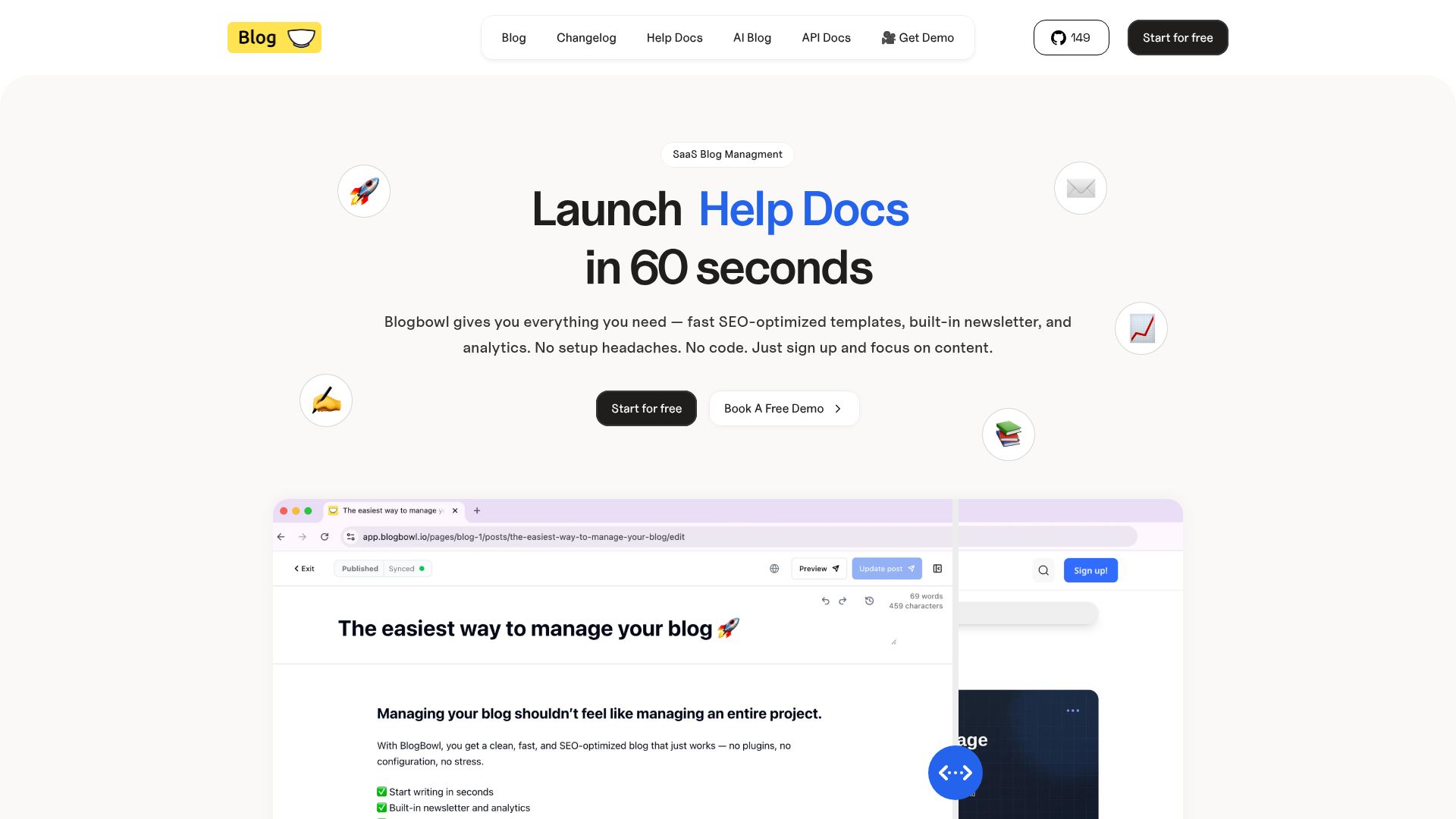
This is why BlogBowl is designed as more than a blogging tool. SaaS teams rarely need “just a blog.” They need a content system. With BlogBowl, you can launch a blog, changelog, and help center in minutes, all with no-code publishing, fast templates, custom domains, and one workflow.
Start with search intent, not keywords alone
Most weak blog posts fail before the first paragraph. They target a phrase, but ignore why someone searched it.
If you want blog seo optimization that works, start by asking:
Is the reader learning?
Comparing?
Trying to solve a problem now?
Evaluating tools?
Looking for a process or checklist?
The 4 intent buckets that matter
Intent | What the searcher wants | Example |
|---|---|---|
Informational | Learn something | "what is blog seo" |
Commercial investigation | Compare solutions or approaches | "best blog seo tools" |
Transactional | Take action or buy | "blog platform with SEO and newsletter" |
Navigational | Find a specific brand or page | "BlogBowl blog platform" |
If the intent is informational, do not open with a hard sell. If the intent is commercial, comparisons and decision criteria matter more than theory.
A simple keyword selection method
Choose topics using this filter:
The keyword is relevant to your product or audience.
The query shows clear intent.
You can provide a better answer than what is already ranking.
The post can link naturally to product, changelog, docs, or newsletter flows.
That is how you build a content engine instead of a random pile of posts.
How to structure a blog post for SEO and conversions
A lot of competitor advice stops at “use H2s and add keywords.” That is too shallow.
The best-performing blog posts are structured for three readers at once:
Humans scanning fast
Search engines parsing hierarchy
Teams measuring performance later
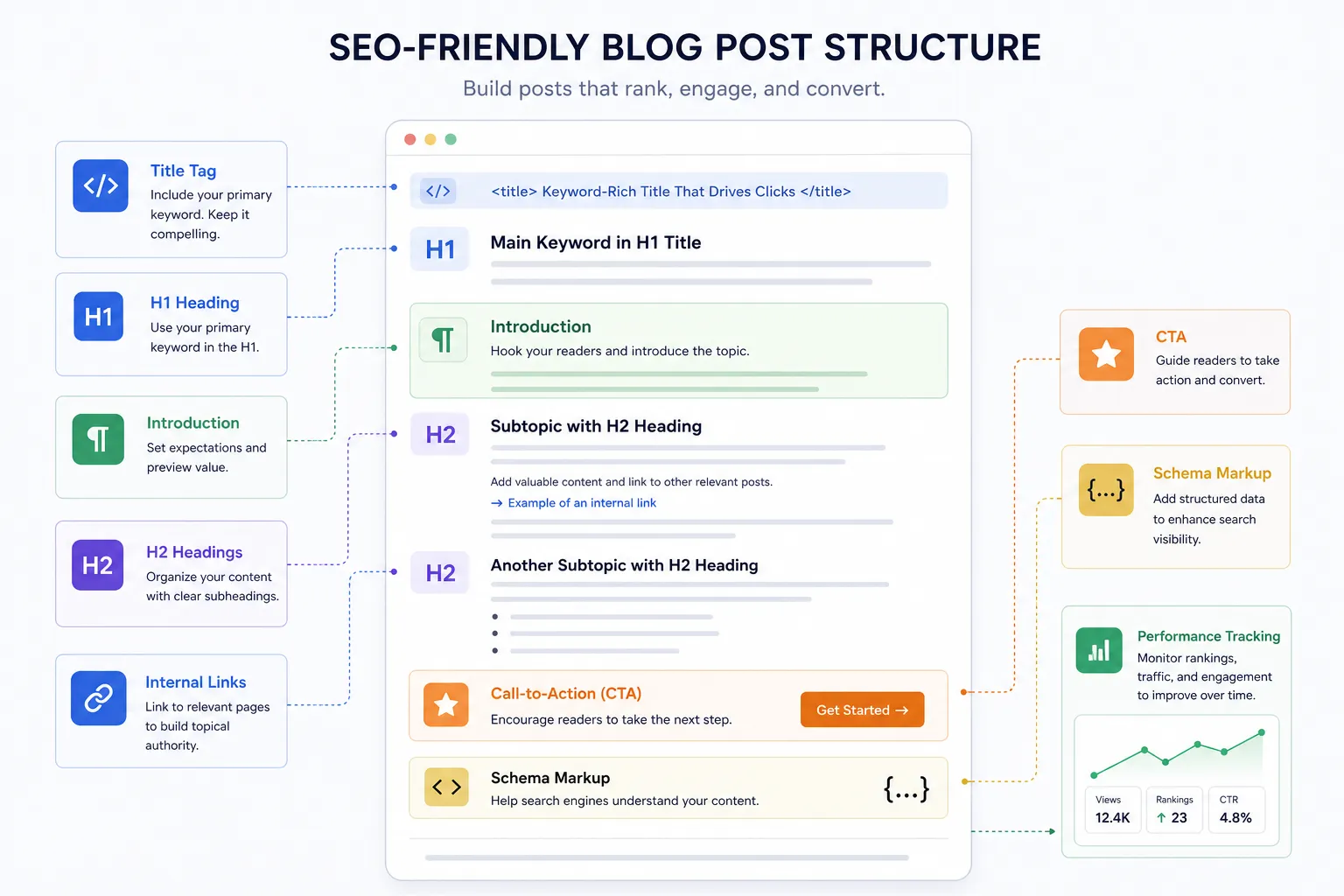
The ideal blog post structure
Clear title with the target phrase
Strong intro that confirms relevance
Answer-first opening section
Logical H2s and H3s
Examples, tables, or frameworks
Internal links to related content
Visuals that clarify the content
Clear CTA matched to intent
What your introduction should do
Your intro has one job: prevent the bounce.
A good intro should:
Confirm the query fast
Show the reader they are in the right place
Promise a practical outcome
Set the scope of the article
Avoid long brand history, broad philosophy, or keyword stuffing. Readers want progress, not runway.
Heading optimization that actually helps
Your headings should do more than organize the page. They should make the answer easier to extract.
Use headings that:
Match subtopics real readers care about
Include natural variations of the keyword
Read clearly when skimmed alone
Move in a logical sequence
Bad heading:
“Important considerations”
Better heading:
“How to optimize blog titles for SEO”
Writing SEO-optimized titles that win clicks
The title tag and headline are still among the highest-impact elements in blog seo.
You need a title that:
Matches intent
Includes the main keyword naturally
Sounds useful, not robotic
Creates curiosity without going clickbait
A simple title formula
Use one of these:
Primary keyword + practical promise
How to + outcome
Complete guide + audience/context
Mistakes/checklist/framework + keyword
Examples:
Blog SEO Optimization: A Practical Guide to Ranking Blog Posts
How to Structure a SaaS Blog Post for SEO
Blog SEO for Startups: What to Fix Before You Publish
12 Blog SEO Mistakes That Kill Organic Traffic
Title best practices
Keep it clear first, clever second
Put the primary keyword near the front if possible
Stay roughly within 50 to 65 characters for search display
Match the title to the actual content
If your title promises “practical guide,” the post must be tactical. If it promises “beginner guide,” do not write for experts only.
How to optimize headings, copy, and on-page elements
This is the core of basic seo optimization for blog content.
Use one clear primary keyword
For this article, the primary keyword is blog seo.
Use it in:
Title
Intro
One or more H2s where natural
Meta title or description
URL slug
Some body copy
Image alt text where relevant
Do not force it. Modern search understands context. Cover the topic deeply instead of repeating the exact phrase awkwardly.
Add semantically related terms
Cluster terms help search engines understand breadth. For this topic, natural supporting terms include:
blog seo optimization
technical seo optimization
website seo optimization
seo optimization guide
blog seo tools
seo optimized
basic seo optimization
seo optimization how to
This is not about stuffing. It is about completeness.
Write answer-first paragraphs
One thing many ranking posts still gloss over: answer-first formatting helps both readers and modern search systems.
Instead of writing three setup paragraphs before the point, lead with the answer, then expand.
Example:
Weak:
“There are many things to consider when working on internal links for SEO…”
Better:
“Internal links help blog posts rank by distributing authority, clarifying topic relationships, and driving readers to relevant pages.”
That format is cleaner, faster, and easier to quote.
Internal linking: the most underused growth lever in blog SEO
If you only publish blog posts and never connect them, you are leaving rankings on the table.
Internal linking helps search engines:
Discover new pages
Understand topic relationships
Pass authority between pages
Identify your most important content
It also helps users keep moving.
The 3 internal link types every SaaS blog needs
Link Type | Purpose | Example |
|---|---|---|
Cluster links | Connect related educational posts | Post about keyword research links to post about blog titles |
Conversion links | Move readers to product pages or signup pages | Post links to BlogBowl features or demo |
Lifecycle links | Connect blog, changelog, and help docs | Educational post links to release note or support doc |
This is one of the biggest content gaps in generic SEO articles. For SaaS, linking should not stop at other blog posts. Your blog should connect to your changelog, help center, templates, and newsletter signup flow.
That is where BlogBowl gives teams a real advantage. Because your blog, changelog, and help docs can live in one platform, it is easier to build structured internal linking across the entire content system without engineering overhead.
Internal linking rules to follow
Link where it helps the reader
Use descriptive anchor text
Prioritize pages that matter commercially
Avoid orphan posts
Revisit older posts and add links to new content
Technical SEO basics for blog posts
You do not need to become a full-time SEO engineer. But you do need the fundamentals.
This is the practical side of technical seo optimization for blogs.
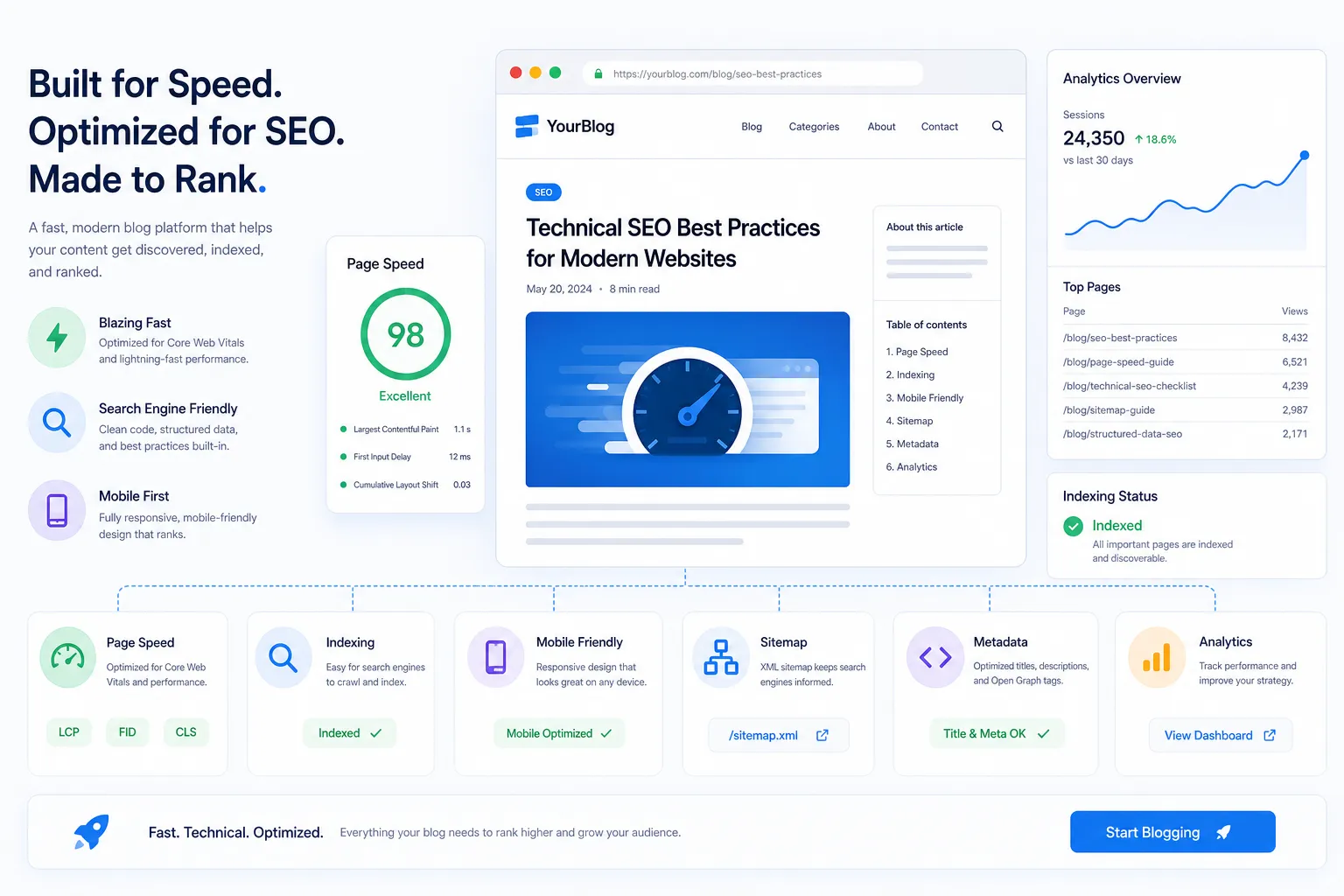
What technical SEO matters most for blog content
Fast load speed
Mobile-friendly design
Clean HTML structure
Crawlable pages
Indexable URLs
Canonical consistency
XML sitemap coverage
Proper meta tags
Structured internal linking
Image optimization
"A 1-second delay in page load time can reduce conversions by 7% and negatively impact search rankings." - Digital Applied, 2026 study
Page speed is not optional
A slow blog loses readers before SEO even has a chance to work.
That means:
Compress images
Avoid bloated themes
Use lightweight scripts
Keep templates fast by default
This is exactly why BlogBowl uses lightning-fast, SEO-optimized templates. Founders and marketers should not have to fight layout bloat or plugin chaos just to publish a simple article.
Mobile UX matters more than teams think
A technically fine page can still perform badly if mobile reading is annoying.
Check:
Font size
Spacing
CTA placement
Image responsiveness
Sticky elements that block reading
Table overflow on small screens
BlogBowl’s mobile-friendly experience helps reduce this friction out of the box, which matters when your audience is discovering content from mobile search, social, or newsletters.
Slug, indexation, and canonical basics
For each post:
Use a clean URL slug
Avoid changing URLs after publishing unless necessary
Redirect old URLs properly
Make sure important posts are indexable
Use canonicals if duplicate or near-duplicate versions exist
Good:
/blog-seo-optimization
Less ideal:
/how-to-do-blog-seo-optimization-for-your-business-blog-in-2026-guide
Image optimization for blog SEO
Images help readability, but they also affect performance and search visibility.
Best practices for blog images
Use descriptive filenames
Add clear alt text
Compress files
Prefer modern formats when possible
Only use visuals that support understanding
Avoid uploading oversized images
Alt text should describe the image, not just repeat keywords.
Bad alt text:
“blog seo blog seo optimization seo”
Better alt text:
“Infographic showing the structure of an SEO-optimized blog post”
Content depth: how much is enough?
A lot of SEO advice still obsesses over word count. That is the wrong goal.
The right goal is completeness relative to intent.
If someone searches a practical query, your post should cover:
What it is
Why it matters
How to do it
Common mistakes
What to measure next
How to know if your post is thin
Your content may be too thin if:
It rephrases generic advice without examples
It does not show a process
It misses decision criteria
It ignores post-publish optimization
It cannot naturally link to next steps
In SaaS, stronger content often includes product context, workflows, templates, screenshots, and examples from actual team use. That is one reason BlogBowl customers can move faster: you can publish practical, branded, structured content without building the system from scratch.
How blog SEO fits into a broader content system
This is another area competitor content often misses.
A blog post should not live alone. It should feed a system.
The highest-leverage content stack for SaaS
Content Surface | SEO Role | Business Role |
|---|---|---|
Blog | Capture organic traffic | Educate and attract demand |
Changelog | Capture product-update and feature searches | Communicate releases |
Help docs | Rank for support and setup queries | Reduce support load |
Newsletter | Re-engage readers | Build owned audience |
BlogBowl is built around this exact stack. You can run all of these surfaces together, publish without code, collaborate across authors, use custom domains, and scale across unlimited blogs, changelogs, and help docs on paid plans.
That matters because SEO compounds faster when your content system is connected.
After publishing: what to do next
This is where a lot of posts underdeliver. Publishing is not the finish line.
Good seo optimization how to advice must include what happens after the post goes live.
Your 30-day post-publish workflow
Days 1 to 3
Check indexing
Test mobile rendering
Validate title and meta appearance
Add internal links from older posts
Week 1
Share through newsletter
Post on founder or brand social channels
Link from relevant docs or product pages if useful
Watch for obvious bounce or layout issues
Week 2 to 4
Check impressions in search data
Review CTR
Improve title if impressions are rising but clicks are weak
Expand sections if average position is close to page one
Add supporting internal links
This is where BlogBowl’s built-in newsletter and integrated analytics become practical, not just nice-to-have. You can collect subscribers with CTA blocks, send or schedule emails, and then watch traffic and engagement from one dashboard instead of stitching together multiple tools.
What to measure for blog SEO performance
You do not need a giant spreadsheet to know whether a post is working.
Focus on a small set of useful metrics.
Core KPIs for blog SEO
Metric | Why it matters | What to do if weak |
|---|---|---|
Impressions | Shows search visibility potential | Improve coverage and internal links |
Click-through rate | Shows title and meta performance | Rewrite title and description |
Average position | Shows ranking progress | Add depth, links, and updates |
Organic sessions | Shows actual traffic gain | Improve intent match |
Time on page | Signals engagement quality | Tighten intro and structure |
Conversion rate | Connects traffic to business value | Improve CTA and offer alignment |
Subscriber growth | Measures owned audience impact | Add stronger newsletter CTAs |
The dashboard mistake to avoid
Do not judge posts too early.
A good blog post may take weeks or months to climb. Instead of asking “Did this rank in 7 days?” ask:
Is it getting impressions?
Is it getting indexed fast?
Is CTR competitive?
Are readers clicking deeper?
Is it contributing to signups or subscribers?
BlogBowl’s Umami-powered analytics dashboard keeps this simple with clear reporting on views, unique visitors, session time, referrers, geography, and actionable trends.
Best blog SEO tools for lean teams
You do not need 12 tools. You need a stack that helps you publish, optimize, and measure.
A practical stack
Need | Tool Type | Why it matters |
|---|---|---|
Publishing platform | BlogBowl | Fast launch, no-code publishing, SEO-ready templates |
Search performance | Search console data | Track impressions, CTR, and ranking progress |
Analytics | BlogBowl analytics | Monitor traffic and engagement simply |
Newsletter growth | BlogBowl built-in newsletter | Capture and re-engage subscribers |
Content planning | Keyword research tool | Find topics and intent patterns |
What makes BlogBowl different from many generic CMS options is speed-to-output. You are not piecing together a blog, email platform, analytics tool, changelog system, and help doc stack. You launch faster and manage everything with less technical drag.
Common blog SEO mistakes to avoid
1. Writing for keywords instead of intent
Ranking starts with matching what the searcher wants.
2. Using vague headlines
If the title is weak, even good rankings underperform.
3. Publishing orphan posts
A post with no internal links is harder to discover and rank.
4. Ignoring technical basics
Slow, messy pages kill both UX and SEO.
5. Never updating posts
Older posts often need refreshed examples, links, and titles.
6. Treating blog SEO separately from the rest of the site
Your blog should support your website, product, docs, and lifecycle marketing.
7. Measuring traffic without conversions
Traffic is useful. Qualified traffic is better.
A concise blog SEO checklist
Use this before and after every publish.
Before publishing
Target one clear primary keyword
Match the post to search intent
Write a strong title
Use clean H2 and H3 structure
Add the keyword naturally in title, intro, slug, and body
Include supporting terms naturally
Add internal links to related posts and key pages
Optimize images and alt text
Check mobile readability
Add a clear CTA
After publishing
Confirm indexing
Add links from older content
Share through newsletter and social
Monitor impressions and CTR
Improve title if CTR is weak
Refresh content if rankings stall
Track conversions, not just sessions
Final verdict
If you want blog seo optimization to actually drive results, think bigger than keywords and smaller than “full-site SEO strategy.”
The winning approach is simple:
Start with intent
Structure posts clearly
Write strong titles and headings
Build internal links intentionally
Cover technical basics
Measure what happens after publishing
Connect your blog to the rest of your content ecosystem
That is how blog seo becomes a growth channel instead of a publishing habit.
And if you want to do that without setup headaches, plugin sprawl, or engineering bottlenecks, BlogBowl is the fastest way to get there. You can launch a blog, changelog, or help center in minutes, publish with no code, use SEO-optimized templates, run newsletters, track performance, collaborate across authors, and scale on your own custom domain from one platform.
If your team wants a simpler way to create an seo optimized content hub that ranks, converts, and compounds, try BlogBowl.